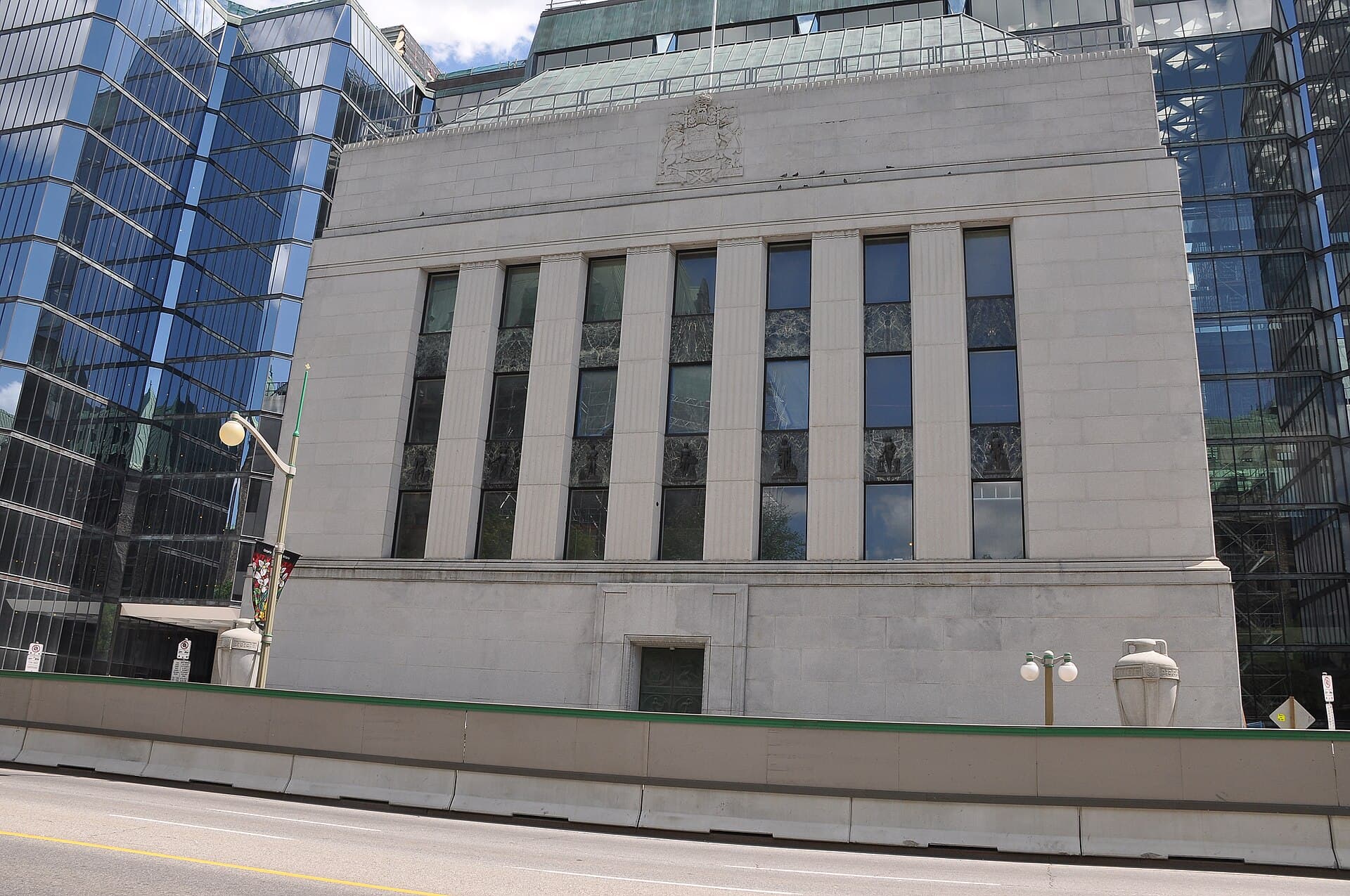
Bank of Canada Faces April 29 Rate Decision Under Oil Shock and Tariff Cloud

The Bank of Canada will issue its next interest rate decision on Wednesday, April 29, in what may be the most closely watched announcement of the year. The central bank's policymakers face an unusually crosscutting set of pressures: a sharp oil price shock driven by the closure of the Strait of Hormuz, slowing growth tied to Trump administration tariffs, and a domestic economy that is uneven across regions and sectors.
Markets and most professional forecasters expect Governor Tiff Macklem and his governing council to leave the policy rate unchanged at 2.25 per cent. The bank held rates steady at its March 18 announcement and again signalled that it intends to be patient as it watches how the global energy disruption and the Canada-U.S. trade dispute work their way through the data.
Where rates stand
The Bank of Canada's policy rate sits at 2.25 per cent, a level it has held for three consecutive announcements. The bank cut rates aggressively through 2024 and into early 2025 as inflation cooled towards the two per cent target, then paused as global trade and energy shocks began to push prices in the opposite direction. The current rate corresponds to a prime rate at major Canadian banks of around 4.45 per cent, with mortgage and consumer lending rates anchored to that benchmark.
Inflation has moved away from the bank's target in recent months. Statistics Canada reported earlier this month that the annual rate of consumer price inflation rose to 2.4 per cent in March, with a 21.2 per cent monthly jump in gasoline prices accounting for much of the increase. The Raw Materials Price Index, which tracks the prices producers pay for inputs, surged 12.0 per cent month over month in March, almost entirely because of higher crude energy prices.
Energy aside, underlying inflation has been more stable. Core measures favoured by the central bank, which strip out volatile components such as energy and food, have been hovering closer to target. That is one reason markets do not expect Macklem to react with a rate hike to the headline number, which is being driven by global rather than domestic factors.
The oil shock backdrop
The largest external force shaping the bank's decision is the Strait of Hormuz crisis. Shipping traffic through the strait, which carries roughly 20 per cent of the world's oil trade, has been largely blocked since late February following an air war between the United States, Israel and Iran. Brent crude has risen from below US$70 a barrel earlier in the year to about US$95 a barrel, with some analysts at major Wall Street banks warning that prices could push higher still if the disruption continues.
For Canada, which is a net energy exporter but also a country where most consumers buy gasoline at retail pumps, the shock has had two-way effects. Western Canadian Select prices have benefited from the higher global benchmark, supporting royalty revenues in Alberta and federal income tax collections from oil and gas firms. At the same time, drivers in major cities have seen pump prices in some markets break the $2 per litre level and Canadian gas price averages have climbed near 198 cents per litre on a national basis.
Prime Minister Mark Carney announced earlier in April that the federal government would suspend the federal fuel excise tax on gasoline and diesel to ease pressure on consumers, and Conservative Leader Pierre Poilievre has called for a broader rollback of all fuel taxes including the carbon levy and the Goods and Services Tax. The Bank of Canada has flagged that any temporary policy moves on fuel taxes will affect headline inflation prints but should not change the underlying inflation picture it watches most closely.
Tariff drag on growth
The second major force is the ongoing tariff dispute with the United States. Section 232 duties on Canadian steel and aluminum have escalated to 50 per cent, with additional duties on lumber and autos, while the formal review of the Canada-United States-Mexico Agreement is set to begin July 1. Carney's new Advisory Committee on Canada-U.S. Economic Relations has been tasked with helping Ottawa navigate the dispute.
Statistics Canada has reported retail and wholesale activity that is holding up better than some had feared. Retail sales rose 0.7 per cent in February to $72.1 billion, with sales up in seven of nine subsectors. Advance estimates suggested that wholesale sales rose another 1.3 per cent in March, supported by machinery and equipment. Yet industry-level surveys show that manufacturers exposed to U.S. trade are reducing capital spending and that some plants in Quebec, Ontario and British Columbia have cut hours or laid off workers.
The Bank of Canada has consistently said that monetary policy is not the right tool to offset trade shocks, which it views as supply-side disruptions. The central bank's role is to keep inflation expectations anchored. That argues for steady policy in the face of trade noise, even if growth softens. The International Monetary Fund's spring outlook nudged Canada's expected 2026 growth lower to about 1.5 per cent, while the Bank of Canada itself has projected growth closer to 1.1 per cent for this year before a recovery in 2027.
What markets expect
Bay Street analysts and bond markets are pricing in a hold on April 29. Mortgage industry analysts have noted that the central bank is likely to remain firmly on the sidelines through this announcement and probably through much of the spring. The bigger debate is about the second half of the year. If the tariff shock proves more damaging than the oil price spike is inflationary, markets expect that the bank will eventually return to cuts, perhaps in the autumn.
The opposite scenario is also possible. If oil prices stay elevated and feed through into broader consumer prices, the bank might be forced to keep policy tighter for longer, even as trade-exposed industries struggle. Macklem and Senior Deputy Governor Carolyn Rogers will hold their usual press conference at about 10:30 a.m. Eastern Time on April 29, alongside the release of the bank's Monetary Policy Report. That report typically contains revised projections for growth, inflation and the output gap, and will be scrutinised for any change in the bank's tone.
The Canadian dollar has been trading in a relatively narrow range, with energy gains offsetting some of the trade pessimism. Currency strategists have noted that the loonie's response to the next decision will depend less on the rate itself and more on how Macklem characterises the balance of risks.
Reaction from political parties
The federal government has said it does not comment on Bank of Canada decisions in advance, in keeping with the central bank's operational independence. Privately, government officials have said they expect the central bank to remain cautious and that fiscal policy, including the upcoming federal budget, will carry more of the weight of any short-term support.
The Conservative opposition has used the inflation backdrop to renew its call for tax relief. Poilievre has argued that the federal government has too many levers ready to push prices up rather than down, and that the carbon levy in particular should be paused. The New Democratic Party has pressed for direct relief to lower-income households, including expanded GST rebate measures and stronger rent supports, particularly in cities where housing costs already account for a large share of household budgets.
The Bloc Québécois has emphasised the regional dimension of the rate decision, arguing that Quebec's exposure to the aluminum tariffs and to lower lumber prices means the province should be considered separately within any federal economic response.
What it means for Canadians
For homeowners and prospective buyers, a hold at 2.25 per cent means little change in mortgage costs in the short run. Variable rate mortgages will not see further reductions, but neither will they face an immediate increase. Fixed mortgage rates, which track Government of Canada bond yields rather than the policy rate directly, have already adjusted to expectations of a long pause and remain close to where they were earlier in the spring.
For renters, the outlook is more uneven. Higher gasoline costs are pushing up utility and transportation prices in many markets, while the Build Canada Homes program is still ramping up its delivery of new affordable units. The federal government's recent agreements with provinces, including a new partnership with Ontario to cut taxes on housing and increase supply, are aimed at structural relief rather than immediate cost reductions.
For workers, the rate decision matters most through the lens of employment. The Bank of Canada will be watching the unemployment rate, hours worked and labour force participation closely. The unemployment rate has drifted up modestly from the lows of 2025, although it remains below historical averages. Sectors most exposed to tariffs are the most likely source of further weakening if trade tensions persist.
Provincial picture
The economic environment is highly uneven across regions. Alberta and Saskatchewan are benefiting from higher oil prices, with provincial revenues climbing and oilfield activity picking up. British Columbia and Quebec have been hit hardest by lumber, aluminum and forestry tariffs. Ontario, with its mix of automotive and steel exposure, is closely tied to the outcome of CUSMA discussions. Atlantic provinces have a smaller direct exposure to the trade shock but are watching the impact of energy prices on lobster and seafood logistics.
Provincial fiscal positions differ accordingly. Alberta has indicated that its budget surplus could grow if oil prices remain near current levels, although Premier Danielle Smith has cautioned about over-reliance on volatile resource revenues. Quebec's new Premier Christine Fréchette has hinted at a series of relief measures that her finance team is finalising. Ontario continues to manage a large deficit and has been pressing Ottawa for more housing and infrastructure support.
The federal government's eventual budget will need to thread these regional differences while delivering on Carney's broader economic agenda, including investments in clean energy, defence and housing. The Bank of Canada will be watching how the budget interacts with monetary policy, particularly whether new spending adds to or moderates inflationary pressure.
What's next
After Wednesday's announcement, the next scheduled rate decision is in June, followed by another in July. By then, the formal CUSMA review will have begun, and the energy market will likely have provided more clarity on whether the Strait of Hormuz disruption is easing or hardening into a longer-term reality. The federal budget is also expected before the summer break, with major implications for fiscal-monetary coordination.
Macklem has been deliberate about emphasising patience. The central bank has stressed that it does not want to overreact to a single inflation print or a single growth shock, and that it will let the data accumulate before acting. That message is consistent with how Macklem managed the Bank of Canada through the post-pandemic inflation surge, when he was criticised both for moving too slowly and for moving too aggressively.
For Canadians, the practical implication is that interest rates are unlikely to fall meaningfully in the coming months, even as energy and tariff pressures distort the headlines. Households planning major purchases or refinancing will need to make decisions on the assumption that the cost of credit will be roughly where it is today. The April 29 announcement, while expected to be quiet, will set the tone for what comes next.
Spotted an issue with this article?
Have something to say about this story?
Write a letter to the editor