Bank of Canada April 29 Rate Decision Arrives as Tariffs and Oil Collide
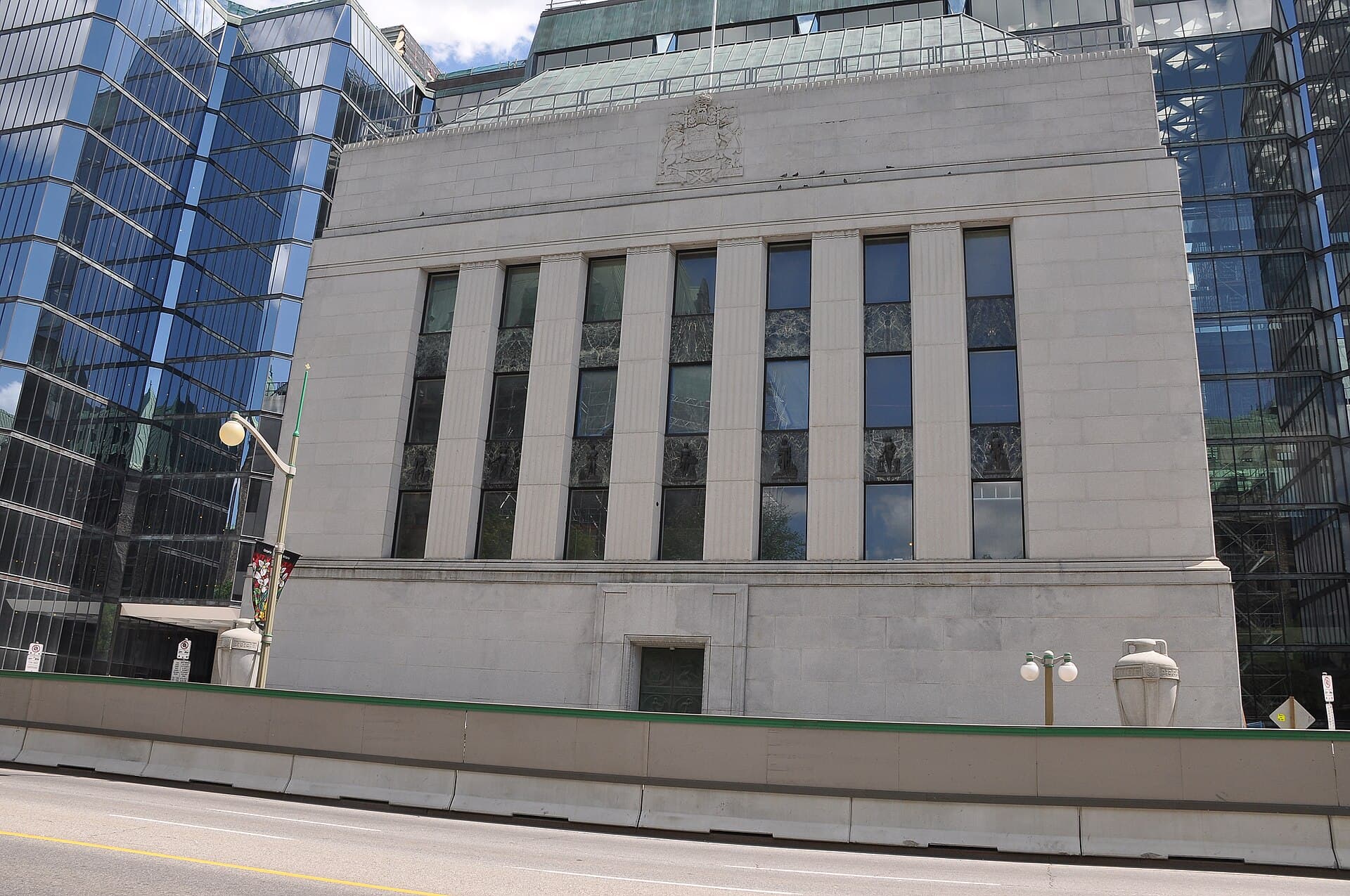
The Bank of Canada releases its next interest-rate decision and Monetary Policy Report on Wednesday, April 29, and Governor Tiff Macklem will face one of the more difficult communication challenges of his tenure. Markets price roughly a 93 per cent probability that the central bank will hold the policy rate at 2.25 per cent, where it has sat since October 2025, but the underlying economic picture has become measurably more complicated since the bank's last MPR in January.
Two forces are pushing in opposite directions. The trade war with the United States, including tariffs that remain in place on Canadian autos, steel, and aluminum, is dragging on growth and weighing on business investment. At the same time, the war between the United States, Israel, and Iran has sent global oil prices sharply higher, with Brent crude trading above $105 per barrel at the end of last week and West Texas Intermediate around $94. Higher energy prices boost Canadian export revenues but also feed through into headline inflation.
Where the data sit
The most recent inflation reading, for March 2026, came in at 2.4 per cent, up from 1.8 per cent in February. The increase was driven in part by energy prices and partly by services costs that have been stickier than the bank previously projected. Core inflation measures, which strip out the most volatile categories, ticked up modestly but remain inside the bank's target range.
The unemployment rate, after rising to 6.7 per cent in February, has held roughly flat. Job creation has been concentrated in services and public administration; goods-producing sectors, especially manufacturing exposed to U.S. tariffs, have shed positions. Statistics Canada's most recent GDP release showed that a drawdown in business inventories subtracted 1.1 percentage points from quarterly real GDP growth in the fourth quarter of 2025, an unusually large negative contribution that suggests firms have been preparing for trade-policy uncertainty by running down stocks.
The case for a hold
The case for holding the rate at 2.25 per cent is straightforward. Inflation is roughly at target, the labour market is soft but not collapsing, and the bank has already cut significantly from the peak of the previous tightening cycle. With trade policy unresolved and the CUSMA review only beginning, the cost of cutting further now is that the bank could find itself easing into a future inflation surprise driven by oil or by a weaker Canadian dollar.
Most major bank economists are forecasting a hold. The C.D. Howe Institute's Monetary Policy Council, an independent advisory group of academics and former central bankers, recommended holding the rate steady at its most recent meeting and signalled that the case for further cuts had weakened.
The case for a cut
The opposite case is also defensible. The trade war is doing meaningful damage to Canadian exports, and the lag between rate cuts and real economic effects is long. Cutting now to insure against a sharper second-half slowdown would be consistent with the bank's risk-management framework. Some commentators have argued that the bank has been too cautious about easing in the face of clear evidence of trade-driven softness in goods-producing sectors.
The challenge for that argument is the Iran war and the resulting oil shock. Brent crude has risen by more than 50 per cent over the past month, and a sustained move higher in energy prices would push headline inflation up at exactly the moment the bank would be trying to justify further easing. The bank's communications have been careful to distinguish between energy-driven inflation, which monetary policy cannot directly offset, and underlying inflation pressures, which it can.
What the Monetary Policy Report will cover
Wednesday's MPR will include updated forecasts for inflation, GDP, and employment, along with a fuller discussion of how the bank is interpreting both the trade and energy shocks. The bank's January MPR included an extended discussion of the CUSMA review and laid out scenarios for how different trade outcomes could affect the Canadian economy. The April MPR is expected to update those scenarios with newer data and to add an analysis of the oil-price implications of the Iran war.
One area to watch is whether the bank revises its estimate of the so-called neutral rate, the policy rate at which monetary policy is neither stimulative nor restrictive. The bank's current estimate is centred around 2.75 per cent, with a range. If trade-policy uncertainty has increased the bank's estimate of structural risks to the Canadian economy, that range could move modestly.
The Carney government context
The decision arrives at a politically significant moment for the federal government. Prime Minister Mark Carney's Liberals secured a majority government on April 13, and the Bank of Canada decision is the first major economic data point of the new majority Parliament. Carney, who served as governor of both the Bank of Canada and the Bank of England, has been deliberately careful to avoid commenting on the bank's specific decisions, but his government has been clear about its view that the trade war is the dominant medium-term risk to Canadian growth.
Finance Minister François-Philippe Champagne is expected to respond to the decision in the days that follow, and the government has signalled that a spring fiscal update is possible if the economic outlook deteriorates further. The bank, for its part, has emphasised that fiscal policy decisions are matters for the government and that monetary policy will be set on the basis of the inflation outlook.
Mortgage and household impact
For Canadian households, the practical effect of a hold would be modest. Variable-rate mortgages would see no immediate change. Fixed-rate mortgage pricing depends primarily on bond yields, which have been moving on a mix of Canadian, U.S., and global signals. Five-year fixed rates remain elevated relative to their 2021 lows but have come down meaningfully from peaks in 2023 and 2024.
Households facing renewal in 2026 are in a different position than those who locked in five-year fixed rates at the bottom of the rate cycle. Mortgage stress in Canadian households has been a recurring concern in the bank's Financial System Review, and Wednesday's MPR is expected to include updated commentary on household credit and arrears.
Business investment and the trade overhang
Business investment in machinery, equipment, and intellectual property has been weak. The bank's quarterly Business Outlook Survey, released earlier this month, showed that firms remain cautious about capital spending as they wait for clarity on trade policy. Some sectors, including auto-parts manufacturing, have explicitly delayed investment decisions pending the CUSMA review.
That uncertainty is the dimension monetary policy struggles to address. Lower interest rates can support investment in normal conditions, but firms holding back because of unresolved trade questions are not primarily responding to the cost of capital. The bank's communications have acknowledged this dynamic, and it is one of the reasons several economists have argued that further rate cuts in the current environment would have limited effect.
What's next
The decision will be released at 9:45 a.m. Eastern on Wednesday, alongside the MPR. Macklem holds a press conference shortly afterward, and several senior bank officials are expected to give speeches in the following weeks that will provide further context on the bank's thinking.
The next decision is scheduled for June, and markets will adjust their pricing for that meeting based on Wednesday's tone. If Macklem signals comfort with the current rate path and emphasises uncertainty as a reason for caution, market pricing for any near-term cut will fade. If he leaves the door open more visibly to further easing, particularly in the event of further trade-policy escalation, market expectations will shift in the other direction.
For ordinary Canadian households and businesses, the headline number will matter less than the bank's framing of where the economy is heading. The April MPR is the first comprehensive update since the Iran war reshaped the global energy outlook and since the Carney majority changed the political calculus. How the bank synthesises those new realities will shape financial conditions for months to come.
Spotted an issue with this article?
Have something to say about this story?
Write a letter to the editor