100 Days to the World Cup: Inside Toronto and Vancouver's Race to Be Ready for June
The FIFA World Cup 2026 kicks off in 57 days. That sentence, which would have seemed improbable even to the organisers who won the tournament bid in 2018, is now the governing reality for planners in Toronto and Vancouver, the two Canadian cities hosting a combined 13 matches between June 12 and July 19. What began this weekend as a 100-day countdown moment, marked with a televised ceremony at Toronto Stadium and civic events on both coasts, is also a deadline-stress test in public view. Very little of what still needs to be finished can slip further.
The tournament in Canada, by the numbers
Toronto will host six matches. The schedule includes Canada's opening game of the tournament, three further group-stage games featuring different confederations, a round-of-32 match and a round-of-16 elimination game. Vancouver will host seven matches, also including group-stage fixtures, one round-of-32 and one round-of-16 game. Combined, the two Canadian venues will see 13 of the 104 tournament matches, a share that reflects Canada's role as junior partner in a FIFA-approved co-hosting arrangement led by the United States and including Mexico.
The tournament itself will span five weeks and 16 host cities across the three countries. FIFA has projected a global cumulative audience of 5 billion viewers, surpassing the 4.7 billion who watched some portion of the 2022 Qatar tournament. Ticketing has already generated more than 4 million applications from Canadian residents alone, according to figures released by Canada Soccer last month.
Toronto Stadium and the BMO Field transformation
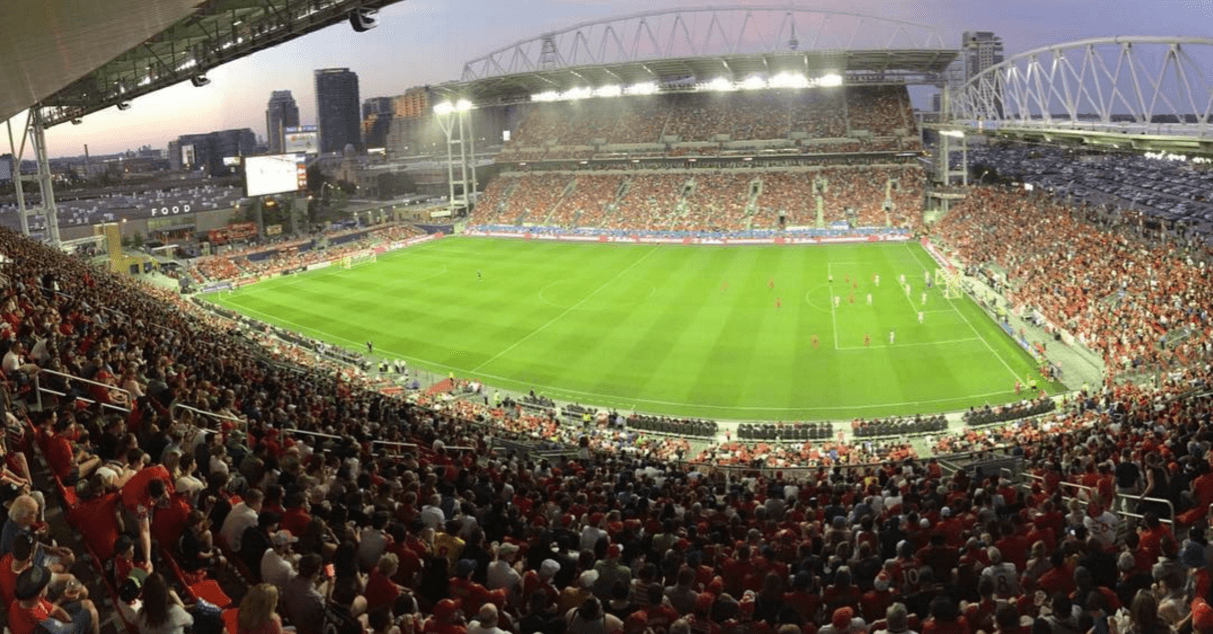
The most visible piece of Canadian World Cup infrastructure is the renamed Toronto Stadium, known for the rest of its life as BMO Field, home of Toronto FC and the Toronto Argonauts. The venue's capacity has been expanded from just over 30,000 to 45,000 in time for the tournament, a temporary configuration that will revert after FIFA's use period ends.
The work has cost roughly $300 million CAD, funded through a combination of federal infrastructure commitments, Ontario provincial contributions, and the City of Toronto's own budget. The last of the temporary seating is scheduled to be installed in late April. Media tours of the facility this past week confirmed that the pitch itself, replaced with a FIFA-specified hybrid grass surface in March, is already in near-match condition.
What remains incomplete is the surrounding exhibition place infrastructure: accessibility improvements, security perimeter upgrades, and the dedicated media and broadcast compound that FIFA requires for any match venue. Sources at Toronto City Hall, speaking on background, described the schedule for those elements as tight but still manageable. None of those sources were willing to rule out a last-minute crunch in the final two weeks before kickoff.

Vancouver and the BC Place configuration
BC Place presents a different set of challenges. The stadium's existing 54,500-seat capacity already exceeds FIFA's minimum requirement for a group-stage venue, and the pitch surface has been prepared to tournament specifications by a combination of BC Pavilion Corporation and FIFA-approved consultants. What Vancouver has instead had to build, largely from the ground up, is the fan experience infrastructure.
The Pacific National Exhibition site will serve as Vancouver's official FIFA Fan Festival location, anchored by a new $104 million amphitheatre with a signature timber roof. The facility, scheduled to open in late May, is being constructed under a compressed timeline that has already absorbed one rain-related delay in March. Contractors speaking to local media last week expressed confidence the amphitheatre will open on schedule. The longer-term use of the venue, after the tournament, has been a point of continued debate in city council.
The transit question
Both host cities face transit capacity questions on match days that no existing Canadian city has had to answer on this scale. Toronto's subway system, particularly the Bloor-Danforth and Yonge-University lines, will need to handle match-day crowds that planners estimate will exceed typical rush-hour volumes by 20 per cent on top of a normal business day.
The TTC has announced extended late-night service on match days, additional streetcar deployment along the Queens Quay and Lakeshore lines, and the resumption of the 193 Exhibition Rocket bus route. The Ontario Line, which will eventually connect to Exhibition Place, will not be operational in time for the tournament.
Vancouver's TransLink system faces a similar scale of planning. The Canada Line and Expo Line, both serving the BC Place area, will operate at tournament-specific frequencies. The challenge is less about capacity, which TransLink's modelling indicates can be absorbed, than about ingress and egress flow around the stadium itself. Crowd management plans, developed jointly with the Vancouver Police Department and FIFA's security team, have been through six iterations since January.
Accommodation, prices and the visitor question
Tournament hotel blocks in both cities have been locked in for months. The challenge now is the broader accommodation market. Airbnb and VRBO inventory in Toronto neighbourhoods within walking distance of Exhibition Place has been pre-booked at rates between three and six times typical spring levels. The City of Toronto's short-term rental bylaw, which technically requires principal-residence status for any listing, will be under renewed enforcement scrutiny during the tournament.
Vancouver faces a sharper version of the same problem. The city's chronic housing shortage, combined with existing short-term rental regulations that limit short-stay inventory, has created projected accommodation shortages for fans travelling without pre-arranged lodging. Tourism Vancouver has publicly advised ticket-holders to secure rooms before arrival, and has highlighted overflow options in Surrey, Burnaby and Richmond.
Security and the federal role
Responsibility for World Cup security falls across three levels of government and a FIFA-designated private security contractor. The RCMP is co-leading the tournament security committee with the Toronto and Vancouver police services. Public Safety Canada has committed roughly $180 million CAD in federal funding specifically for tournament-related security operations.
The security plan, which has been discussed publicly only in broad terms, includes dedicated protective details for team delegations, vehicle perimeters around stadiums, air-traffic restrictions above both cities during match days, and a coordinated cyber-security operation centre. No specific threats against the tournament have been publicly disclosed.
Legacy and the longer-term question
Every major international sporting event in Canada has prompted a version of the same question: what remains after the circus leaves town. The 1976 Montreal Olympics produced a stadium that took three decades to pay off. The 1988 Calgary Winter Games produced facilities that continue to anchor amateur sport training in western Canada. The 2010 Vancouver Winter Olympics left housing legacies that have been debated ever since.
The FIFA World Cup is a shorter event than either Olympics, but its temporary nature has not prevented considerable public investment. The $300 million poured into Toronto Stadium will revert, after the tournament, to supporting Toronto FC and the Argonauts in a facility that will retain approximately 38,000 seats, up from the pre-expansion 30,000. Vancouver's amphitheatre investment will anchor the Pacific National Exhibition's summer programming for decades. The question of whether these investments are worthwhile is, as always, politically contested.
The commercial dimension
The tournament's commercial structure is entirely controlled by FIFA, a structure that has drawn substantial criticism in every host country for a generation. Canadian businesses will benefit from visitor spending, tournament-related hospitality contracts, and the longer-term promotional effect of two Canadian host cities appearing on the world's most-watched television broadcast. They will also navigate strict FIFA rules on trademark protection, ambush marketing, and the exclusion of non-sponsor businesses from the area around stadiums during match days.
Canadian Olympic Committee marketing executives, who have experience managing these kinds of tensions, have advised Tourism Toronto and Destination Vancouver on how to position local businesses for the tournament environment. The guidance boils down to a simple rule: lean into visitor spending, steer clear of anything that might be construed as infringing FIFA's trademark portfolio. The fine line between the two is where most of the commercial value, and most of the legal risk, will be found.
The Canadian men's team factor
For Canadian fans, the emotional centre of the tournament is the opening match featuring the Canadian men's national team. The team, which qualified automatically as a co-host nation, will be the first Canadian men's side to play in a World Cup on home soil. Head coach Jesse Marsch has spent the past year building depth and cohesion around captain Alphonso Davies, striker Jonathan David, and rising midfielder Ismael Koné.
The group-stage draw, completed in December, placed Canada in a group that includes Belgium, South Korea and a qualifier to be determined through the intercontinental playoffs. Optimism about a deep run is measured. Realistic hopes among Canadian coaching staff centre on advancing out of the group and, ideally, winning a knockout round match on home soil.
The volunteer programme and cultural moments
FIFA's volunteer programme for the 2026 tournament is the largest sport volunteer initiative in Canadian history. More than 18,000 volunteers have been recruited across the two host cities, with training programmes running through April and May. The applications, which closed last autumn, drew more than 120,000 Canadian respondents, a response rate that exceeded organiser expectations and provided a selection pool deep enough to produce high-quality volunteer teams.
Cultural programming around the tournament will extend well beyond match days. Both Toronto and Vancouver have planned month-long cultural festivals running from the opening match through the round of 16. Indigenous welcome ceremonies, officially integrated into the tournament's opening events, have been developed in consultation with the Mississaugas of the Credit First Nation in Toronto and with the Squamish, Musqueam and Tsleil-Waututh nations in Vancouver. The cultural programming has been designed to present Canada's diverse identity to an international audience without succumbing to the cliches that have marked previous major sporting events.
What remains to be delivered
The final 57 days between now and kickoff will be defined by three things: completing construction of the remaining fan festival and stadium-adjacent infrastructure, finalising transit and security coordination between multiple agencies, and managing the expectations of millions of Canadians watching their first home World Cup. Organisers at both FIFA and the host city committees have been publicly confident and privately careful. One senior official involved with Vancouver's planning described the situation in April as on-track but unforgiving.
The 100-day mark, in other words, arrived with the tournament framework largely in place and the finishing work clearly visible. Whether that finishing work is complete in time, and in a condition the country is proud to show to the world, will be settled in the 57 days still to come.