Frechette Meets Carney in Ottawa, Digs In on Notwithstanding Clause
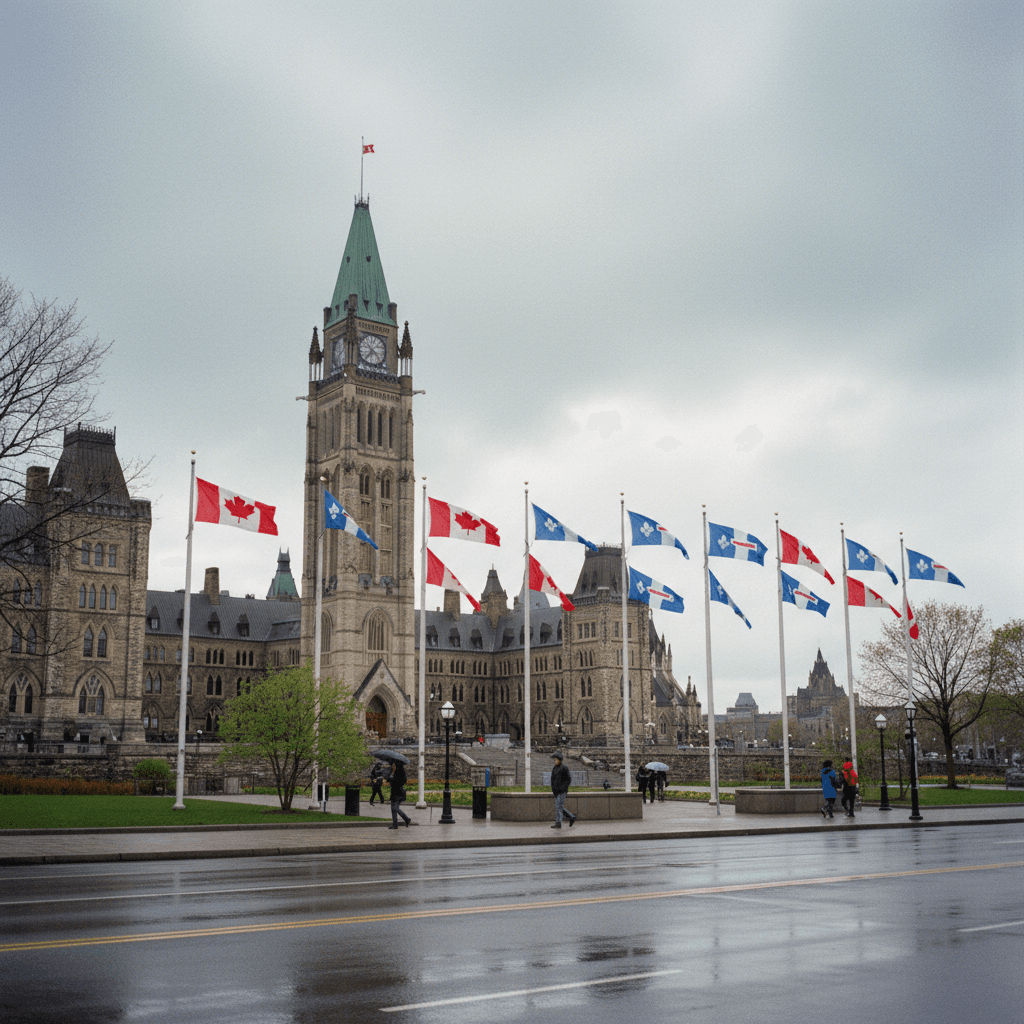
Quebec Premier Christine Frechette met Prime Minister Mark Carney in Ottawa on Friday for the first time since her swearing in, in a meeting that served as an early test of how her Coalition Avenir Quebec government will manage relations with a Liberal majority in Ottawa. Frechette arrived promising to fight, in her words, tooth and nail to defend Quebec's use of the notwithstanding clause of the Canadian Charter of Rights and Freedoms. She left, by her own account, relieved by the tone Carney struck on Charter questions.
The two leaders emerged from about ninety minutes of discussions with a carefully choreographed message of cooperation, emphasising areas of agreement on economic development, energy, immigration and the review of the Canada, United States and Mexico Agreement. They also signalled that significant fault lines remain. The notwithstanding clause, Quebec's secularism and language laws, and the proper division of immigration powers all continued to hover over the meeting.
Frechette is less than a week into her premiership, having been sworn in on April 15 after Francois Legault stepped down. She inherits a CAQ government that won a narrow mandate at a moment of deep Quebec anxiety about identity, affordability and trade. Her first Ottawa visit was a chance to signal continuity with Legault's constitutional stance while opening a new working relationship with a prime minister she and her predecessor have long respected.
The first face to face
The two leaders met at the Prime Minister's Office in Ottawa. They posed briefly for photographers before moving into a closed-door bilateral meeting, with senior ministers and staff in attendance for parts of the discussion. Carney's office described the agenda as covering immigration, housing, major projects, defence, and the Canada, United States and Mexico Agreement review. Frechette's office emphasised Quebec's insistence on the notwithstanding clause and on protection for the province's distinct culture and language.
The tone of the meeting was cordial, according to both camps. Carney and Frechette have a long-standing familiarity dating back to her tenure as Quebec's minister responsible for the economy, innovation and immigration in the Legault cabinet. The prime minister, for his part, has long held business and academic links to Montreal, dating back to his time at the Bank of Canada. Aides said that shared background helped establish a collaborative mood from the outset.
Frechette went into the meeting having spent the week managing internal CAQ politics as she finalised her cabinet. She emerged describing the conversation as constructive, and expressing particular satisfaction with Carney's language on the Charter. Carney, for his part, was careful to steer clear of any specific commitment that could be read as either a concession on Quebec's constitutional positions or an affront to them.
The notwithstanding clause flashpoint
Quebec's use of Section 33 of the Charter, the notwithstanding clause, has dominated federal-provincial relations since the Legault government invoked it to shield its secularism law and its French-language law from judicial challenges. The previous prime minister had threatened to intervene at the Supreme Court, arguing that the clause should not be used pre-emptively to override fundamental rights. Quebec argued that the clause is a full and legitimate constitutional tool, and that pre-emptive use is an accepted part of Canadian practice.
Frechette arrived in Ottawa pledging to defend that position. In remarks before the meeting, she said that Quebec will continue to rely on the notwithstanding clause where it chooses and that she will oppose any federal effort to restrict its use. She said the clause is part of the compromise that underwrote the Charter in 1982, and that any attempt to curtail it would amount to rewriting the Canadian constitutional bargain.
Carney has approached the question more carefully than his immediate predecessor. He has said that his government will not intervene against Quebec at the Supreme Court in the current challenges to Bill 21 on state secularism, a shift from the previous Liberal position. After Friday's meeting, Frechette said she was reassured by Carney's public statements on the Charter, while also noting that Ottawa and Quebec retain different views on how the clause should be used over the long term.
Where the two sides agreed
Both leaders pointed to a series of shared priorities. The most immediate was the Canadian economy and the looming review of the Canada, United States and Mexico Agreement, scheduled to begin formally in the coming months. Frechette said she received assurances that Quebec's supply management system, language rules and cultural industries would be protected as red lines in any negotiation with Washington and Mexico City.
The two leaders also said they are aligned on the need to move faster on economic development and energy. Frechette told reporters that Carney supports Quebec's ambition to grow its aluminum, aerospace, critical minerals and battery industries, and to expand hydro power in partnership with the federal government's clean electricity investment tax credits. Carney described Quebec as an indispensable partner in the government's industrial strategy, particularly its clean energy component.
Both also expressed interest in accelerating federal defence procurement from Quebec suppliers. With Canada having reached the NATO two per cent defence spending target and the federal government now aiming toward a higher commitment, Frechette said Quebec expects to see its aerospace, shipbuilding and electronics industries benefit. Carney agreed that Quebec expertise is essential to the build-up and that procurement rules will reflect that.
Defence procurement on the table
The defence file took centre stage in Friday's discussions. Quebec is home to major aerospace manufacturers, including Bombardier, CAE and Heroux-Devtek, as well as a cluster of component suppliers in Montreal and the Monteregie region. The provincial government has been pushing hard for federal procurement commitments that could anchor thousands of well-paid engineering and manufacturing jobs.
Frechette said she used the meeting to press for specific allocations of defence contracts to Quebec, particularly for maintenance of existing fleets, simulation and training services, and new-build military aircraft. Carney is reported to have said that Quebec should expect substantial benefit from upcoming announcements, without committing to specific dollar figures. Further procurement details are expected to be unveiled ahead of and during the Spring Economic Update on April 28.
The Davie shipyard in Levis, Quebec, has been a particular focus. The yard is now part of the National Shipbuilding Strategy, and both governments have an interest in ensuring a steady flow of work there. Frechette said she raised the yard's status directly and that Carney acknowledged the importance of its role in the coast guard and icebreaker programmes.
USMCA review and supply management
The upcoming review of the Canada, United States and Mexico Agreement was the other major economic focus. Quebec has strong interests in dairy and poultry, sectors covered by the supply management system, as well as in the aluminum industry and the aerospace supply chain. American tariffs on Canadian steel, aluminum and autos have already hit Quebec suppliers, and the province's manufacturing base is vulnerable to any further escalation.
Frechette told reporters after the meeting that Carney assured her that Canada's supply management system, language and cultural industries would be protected in the upcoming review. That echoes a commitment the federal government made last year in Parliament, but Frechette said it was important to hear it restated directly to Quebec. The province has warned that any concession on supply management would be deeply damaging to rural economies across the province.
Carney's position matches his broader message that Canada will take a hard line on core sectors in any renegotiation with Washington. The prime minister has repeatedly said that the era of close economic integration with the United States has ended and that Canada must build its negotiating leverage through investment, diversification and domestic manufacturing. Quebec leaders have echoed those themes, in a rare alignment on trade between Quebec City and Ottawa.
Immigration and housing
Immigration was a more contested area. Frechette has signalled continuity with Legault's decision to cut permanent immigration to Quebec to around 45,000 a year, a reduction of roughly forty-five per cent from earlier levels. The federal government, under Carney, has been seeking closer coordination with provinces on immigration levels and on regional distribution of newcomers, and has floated reforms to the Express Entry system.
Frechette said she reiterated Quebec's authority over its own immigration levels and its selection criteria for economic immigrants, and that Ottawa did not contest those powers. The two sides agreed to continue technical discussions on temporary resident volumes, including international students and temporary foreign workers, which have been a flashpoint in Quebec's debate over housing and the French language.
Housing was another common theme, with the CAQ and the Liberal governments both under pressure from voters on affordability. Frechette said Carney signalled openness to new federal funding arrangements that respect Quebec's jurisdiction, including direct transfers that can flow through provincial housing agencies. Final details are expected to be announced in coordination with the Spring Economic Update.
What's next
The first Frechette-Carney meeting sets the tone for a relationship that will have to navigate a busy political calendar. The Spring Economic Update on April 28 will be the next major marker, followed by premiers' meetings at the Council of the Federation in the summer. The CUSMA review is expected to ramp up over the balance of 2026 and into 2027.
The constitutional flashpoint over the notwithstanding clause is unlikely to fade. Bill 21 and Bill 96 court challenges continue to move through the legal system, and the federal government's approach at the Supreme Court will be closely watched in Quebec. Frechette has signalled she will continue to defend the province's right to invoke Section 33, while Carney will likely keep his options open on future interventions.
For voters, Friday's meeting offered a first read on how Frechette handles the federal-provincial spotlight and how Carney balances his majority mandate with a nationalist CAQ government in Quebec City. The early signs suggest both leaders want to emphasise cooperation on economic files while managing constitutional disagreements at arm's length. Whether that equilibrium holds as the CUSMA talks intensify, and as court challenges to Quebec's laws approach their end, will be the test of their working relationship.