Raptors Drop Game 1 in Cleveland as Cavaliers Flip the Season Series Script, 126-113
The Toronto Raptors walked into Rocket Mortgage FieldHouse on Saturday carrying a 3-0 regular season sweep of the Cleveland Cavaliers, a starting point guard who had given them 70 games of career-best production, and a quietly confident belief that they were the kind of opponent Cleveland would rather not have drawn in the first round. Ninety-six minutes later, after a 126-113 loss built on one catastrophic transition sequence across the second and third quarters, they were down 1-0 in the series, without Immanuel Quickley, and staring at the outline of exactly how much harder the playoff version of this Cavaliers team can be than the regular-season one.
How the game got away
The Raptors were in it for most of the first half. RJ Barrett's three-pointer with just over a minute left in the second quarter pulled Toronto to within 45-41, and the road building block of a tight contest against a higher seed was still available. Then Cleveland stopped playing like a team that had lost three straight to Toronto in the regular season.
The Cavaliers closed the second quarter on a run that bled into the opening of the third and produced a 27-9 stretch over roughly eight minutes of game time. Max Strus, Cleveland's bench scorer, produced 11 points during the spurt and hit all three of his three-point attempts. The Raptors, who had been competitive on the scoreboard, watched a four-point deficit balloon into a double-digit hole that they never meaningfully threatened to close.
When the third quarter ended, Cleveland led 95-79. When the fourth quarter ended, the scoreboard read 126-113. The margin was comfortable enough for head coach Kenny Atkinson to pull his starters with plenty of time remaining, a luxury the Raptors had been hoping to deny him.
Donovan Mitchell's statement
Donovan Mitchell led the Cavaliers with 32 points, a performance that absorbed most of the post-game highlight time but that his teammates and his coaching staff insisted was simply the opening act of a long series. Mitchell has been the single most important Cleveland player over the past three seasons, and his production in Game 1 established the pattern the Cavaliers have been trying to lock in: a 30-point scoring night from their star guard, supplemental scoring from two or three other starters, and at least one breakout performance from a role player.
Max Strus filled that last role with 24 points off the bench, easily his best game against Toronto this season. James Harden added a double-double with 22 points and 10 assists, a performance that reflected the veteran's continued ability to produce in the half court when defences collapse onto Mitchell. The three of them combined for 78 points, exactly the kind of offensive balance the Cavaliers had been unable to produce in three regular-season losses to the Raptors.

What Toronto got from its core
The Raptors' regular-season strengths were on display even in defeat. RJ Barrett scored 24 points and looked like the most comfortable Toronto player on the floor throughout. Scottie Barnes added 21 points and continued to show the maturing two-way versatility that has been the organisational bet since his 2021 draft selection. The two of them combined for 45 points on efficient shooting, a level of production the Raptors can build on.
The issue was what happened around them. Gradey Dick, whose three-point shooting has been a key piece of the Raptors' offensive architecture, finished quiet. Ochai Agbaji provided energy but limited scoring. Brandon Ingram, whose late-season acquisition remains one of the most scrutinised roster decisions in the franchise's recent history, was effective in stretches but could not generate the kind of second-unit scoring that would have allowed head coach Darko Rajakovic to rest his starters more aggressively.
The Jamal Shead story
With Immanuel Quickley ruled out for Game 1 roughly four hours before tip-off, Rajakovic turned to rookie point guard Jamal Shead for the first playoff start of his career. Shead, the 45th overall pick in the 2024 draft out of Houston, had earned increasing minutes through the regular season as his defensive intensity and shot-making became part of the Raptors' second-unit identity.
He was the best part of Toronto's evening. Shead finished with 17 points, including five three-pointers, and was visibly comfortable in the moment. His ability to defend Mitchell in spurts, while not preventing the Cavaliers' star from producing his 32-point night, at least made those buckets costly in terms of effort. Post-game, Rajakovic was effusive about Shead's readiness. The head coach nonetheless made clear, in the same breath, that Quickley's absence had been felt on the floor.
The Quickley injury and the series implications
Immanuel Quickley suffered a mild right hamstring strain during the Raptors' regular-season finale against Brooklyn. The team listed him as out for Game 1 on Saturday morning. His availability for Game 2, scheduled for Tuesday night in Cleveland, has not been publicly confirmed.
Quickley's regular-season production made him the single most important perimeter creator in Toronto's rotation. The five-year veteran averaged 16.4 points, a career-high 5.9 assists and 4.0 rebounds across 70 games this season, numbers that reflect his evolution from a Knicks bench scorer into a legitimate starting point guard capable of running a playoff offence. His ability to manipulate pick and roll coverages, particularly against the specific kind of drop coverage Cleveland tends to deploy with Jarrett Allen, was a significant part of Toronto's plan for this series.
Without him, the Raptors spent Game 1 shifting more creation responsibilities onto Scottie Barnes, which the Cavaliers defended effectively by throwing multiple bodies at Barnes whenever he touched the ball above the break. That adjustment, which Cleveland will likely repeat in Game 2, is the kind of defensive pattern Quickley would have complicated with his pull-up shooting and his off-ball gravity.
The three-point line
Cleveland shot 17 of 42 from three-point range, a 40.5 per cent clip that represents exactly the kind of volume and efficiency the Cavaliers need to turn the series. Toronto, by contrast, was 13 of 34 from beyond the arc, a 38 per cent conversion rate that was respectable but volume-limited. The raw difference, Cleveland's 51 points from three versus Toronto's 39, accounted for most of the final 13-point margin.
Strus's three-point performance, five of eight from the field with all three of his second-quarter-into-third-quarter threes falling during the decisive run, was the individual story of the game from a shooting perspective. The Raptors' perimeter defence, ranked in the middle of the league during the regular season, was pulled out of shape by Cleveland's ball movement in that stretch.
Coaching adjustments to watch
Darko Rajakovic has earned a reputation, in his two-plus seasons leading the Raptors, for being an aggressive in-series adjuster. His use of unconventional lineups, particularly small-ball groupings that feature Barnes at centre, have produced tactical surprises in earlier playoff-less seasons. Against Cleveland, he will need to find ways to generate better rim pressure, slow down Mitchell's one-on-one opportunities, and get more from his second unit.
Kenny Atkinson, now in his first full season as Cleveland's head coach after replacing JB Bickerstaff in the summer, has his own adjustment menu. The Cavaliers leaned heavily on a guard-heavy rotation through the regular season. Against a Toronto roster that features Barnes and Ingram as wing-forwards capable of punishing smaller lineups, Atkinson's willingness to play Allen and Evan Mobley together for extended stretches will be a key variable through the series.
The broader NBA context
Game 1 of the Raptors-Cavaliers series played out against the backdrop of a broader first-round schedule that has featured, through Saturday night, a striking home-team dominance. Every home team that played on the opening weekend of the playoffs has, so far, won Game 1. Whether that pattern reflects a structural home-ice advantage in the current NBA, or simply the randomness of a single weekend's results, will be clearer by next Thursday.
The Oklahoma City Thunder, top seed in the West and the presumptive favourite to repeat as champions, opened their series with a comfortable win over Phoenix on Saturday afternoon. The Denver Nuggets, led by Nikola Jokić, showed the kind of methodical mastery over the Minnesota Timberwolves that has become the defining feature of Jokić's playoff résumé. The Knicks and Hawks opener produced the kind of physical Eastern Conference basketball that reminded observers why Madison Square Garden remains the most electric playoff atmosphere in the league.
What Canadian basketball fans should watch for
The Raptors remain the only NBA franchise based in Canada, and the team's success remains intertwined with the broader health of basketball culture across the country. The 2019 championship run, fuelled by Kawhi Leonard and a deep supporting cast, triggered a measurable boom in youth basketball participation across Toronto, Montreal, Vancouver and Calgary. Whether the 2026 Raptors can approach that kind of playoff impact depends in substantial part on how this series turns.
The broader Canadian basketball story extends well beyond the Raptors. Shai Gilgeous-Alexander is the reigning MVP and the face of the Thunder's title defence. Jamal Murray continues to lead the Nuggets alongside Jokić. RJ Barrett, now in his second full year as a Raptor after the trade from New York, represents the kind of Canadian star whose playoff performance has direct significance for the country's basketball identity. A strong Raptors showing in this series, even in defeat, would further elevate the Canadian presence across the playoffs.
What's next
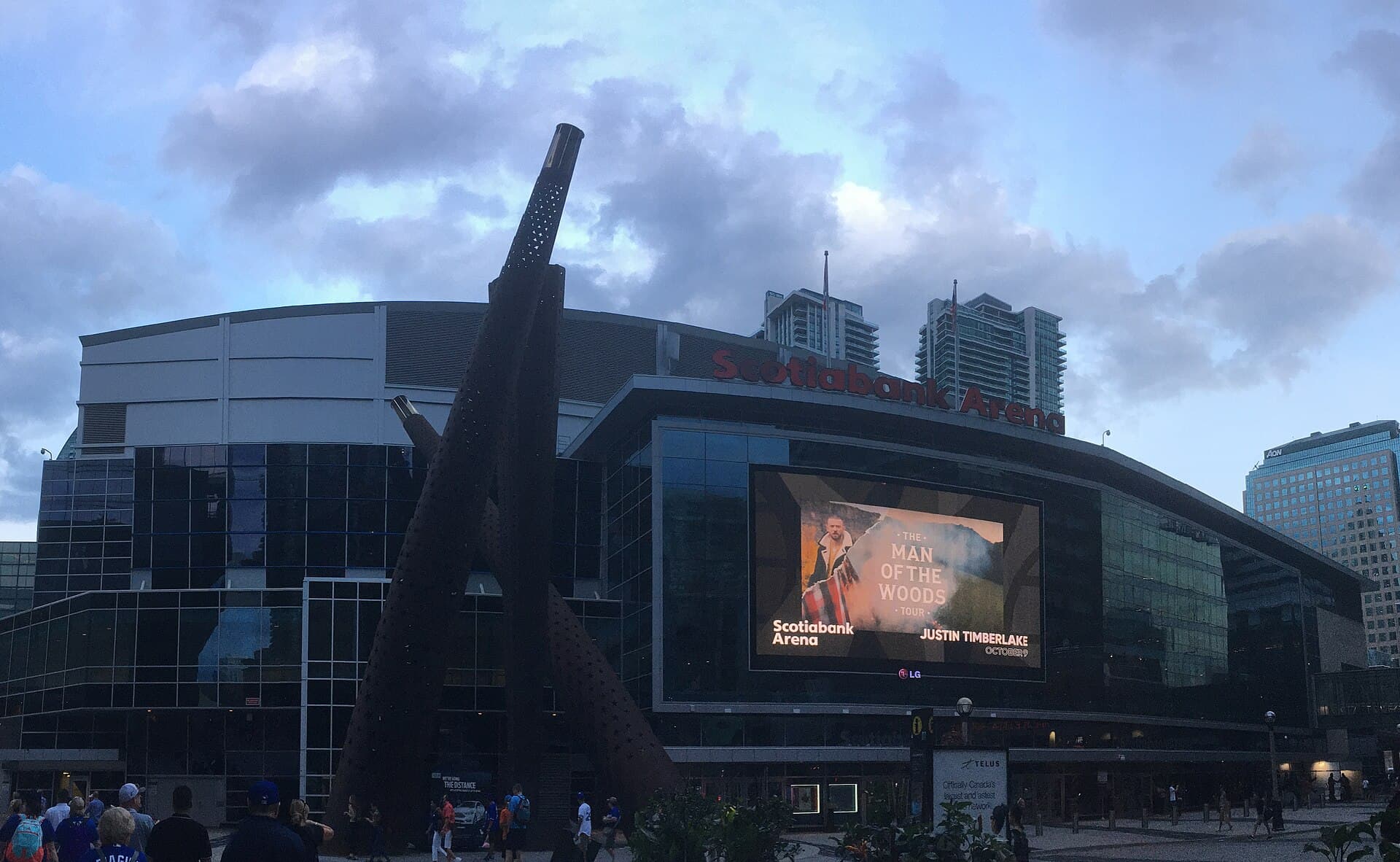
Game 2 is scheduled for Tuesday night at Rocket Mortgage FieldHouse. The series then shifts to Scotiabank Arena in Toronto for Games 3 and 4 on Thursday and Saturday. Best-of-seven. Home court belongs to Cleveland.
The immediate question is Quickley's health. If he returns for Game 2, the Raptors reinstall their preferred starting lineup and bring the offensive diversity that produced their three regular-season wins over Cleveland. If he misses another game, Jamal Shead's emergence becomes a central variable in whether Toronto can come home with a split. Darko Rajakovic's adjustments, particularly on defending Cleveland's transition pace and the Mitchell-Strus pick-and-roll actions that produced the decisive second-quarter run, will shape the strategic picture.
A 1-0 series deficit is not catastrophic. The Raptors were expected to enter the series as underdogs even at full strength, and a split in Cleveland remains a realistic goal. What Saturday night confirmed is that the regular-season sweep has now been paid back with interest. The real series starts Tuesday.