Fréchette Targets Grocery and Housing Costs in Her First Weeks as Quebec Premier

Quebec Premier Christine Fréchette is preparing to use her first weeks in office to push through a package of cost-of-living measures, with a particular focus on grocery prices, rental affordability, and access to government services. The new CAQ leader, sworn in on April 15 after winning the party's leadership race on April 12, has signalled that the National Assembly's return on May 5 will be the first real test of her ability to convert leadership-race rhetoric into legislative action.
Who Fréchette is
Christine Fréchette won the CAQ leadership with 57.9 per cent of the vote, defeating Bernard Drainville. She succeeded François Legault, who announced his departure earlier in the year after a long stint in office. Before her elevation to the premier's office, she was Quebec's minister of immigration, francisation, and integration, and a former federal economic-development official.
Her swearing-in ceremony took place on April 15 in Quebec City. She announced a streamlined cabinet within days, choosing to retain several key Legault-era ministers in their portfolios while rotating others into more visible roles. The cabinet rebuild was widely interpreted as continuity-with-emphasis, signalling that Fréchette is not seeking to dramatically rewrite CAQ priorities but is determined to demonstrate her own emphasis on affordability and competence.
Within the CAQ caucus, Fréchette inherits a party that has lost some of its electoral edge from the 2018 and 2022 victories. Polling through 2025 had the CAQ trailing both the Liberals and Québec Solidaire in some surveys, with discontent over cost of living, public services, and immigration policy weighing on the government's standing. Her leadership campaign explicitly framed itself as a reset on those fronts.
The grocery and rent agenda
Fréchette has identified grocery costs as her single most prominent first-weeks file. "Grocery costs are hitting budgets hard, as are rent and housing costs," she said in remarks following her swearing-in. "These are two sectors where I want to act quickly." The package she has signalled, while not yet released in full detail, is expected to include changes to the province's competition oversight in the grocery sector, support for local production, and possible adjustments to taxes on essential goods.
On housing, the government's options are constrained by the broader inflation environment and by the limits of provincial jurisdiction. Quebec's Tribunal administratif du logement, which adjudicates rent increases between tenants and landlords, has been at the centre of past efforts to manage rental affordability. Fréchette's team has signalled openness to expanding the tribunal's mandate, accelerating purpose-built rental construction through provincial financing, and tightening rules on short-term rentals in housing-stressed neighbourhoods.
Government services are the third leg of the early-weeks agenda. Fréchette has committed to faster processing for health card renewals, driver's licences, and a range of frequently used administrative interactions, after years of complaints about backlogs and customer-service quality.
Federal context
The Quebec government's affordability push lands in the same week as the federal Bank of Canada's decision to hold the policy rate at 2.25 per cent and warn of higher inflation ahead. With CPI inflation expected to reach roughly 3 per cent in April, driven primarily by gasoline prices, the political pressure on provincial governments to deliver visible relief is intense.
Federal-provincial relations between the Carney Liberals and the new CAQ government are widely expected to be cooperative on most files. Fréchette's previous federal experience and her relatively pragmatic posture on intergovernmental affairs have given her a reputation as a capable interlocutor. She has not, however, signalled any retreat from longstanding Quebec priorities on language, immigration, and provincial fiscal autonomy, and there are obvious flashpoints in the months ahead.
One of those flashpoints is immigration. The federal-provincial dispute over annual permanent-resident admission levels and over the financial arrangements that accompany them carried over from the Legault era and into the Fréchette period. Whether the new premier strikes the same combative posture as her predecessor or finds room for a more pragmatic settlement is one of the open questions of her early tenure.
Opposition response
The Quebec Liberal Party, led by Marc Tanguay, has been pressing Fréchette to deliver concrete results rather than reannouncing measures her own government has previously committed to without follow-through. Tanguay's caucus has flagged housing in particular, citing what it characterises as a chronic shortfall in actual housing starts compared with stated provincial targets.
Québec Solidaire, with co-spokespersons Ruba Ghazal and Gabriel Nadeau-Dubois, has pushed for stronger interventions on rent control and on grocery oversight, including the possibility of government-controlled price reviews on essential staples. The Parti Québécois, polling competitively under Paul St-Pierre Plamondon's leadership, has been emphasising broader sovereignty and fiscal questions while keeping pressure on the premier on cost-of-living issues.
The opposition mood is sharper than the polite reception the new premier might have hoped for, in part because all three opposition parties are eyeing a possible Quebec election as early as next year and are positioning accordingly.
Business and labour
Quebec's grocery sector includes the major chains Loblaw, Metro, and Sobeys, along with the Quebec-based Couche-Tard and a network of regional and independent retailers. Industry associations have urged the government to focus on supply-side and cost-input questions rather than price controls, arguing that competition is already fierce and that margins remain modest.
Labour groups, including the FTQ and the CSN, have welcomed the government's affordability framing while pressing for more direct measures, including stronger wage growth in sectors such as health and education, where the province's collective agreements remain a major fiscal item.
Construction industry voices, including the Association des professionnels de la construction et de l'habitation du Québec, have asked for clarity on housing-related programs that could trigger meaningful new starts, including changes to property-transfer tax treatment and to municipal development charges in cooperation with cities.
The May 5 return
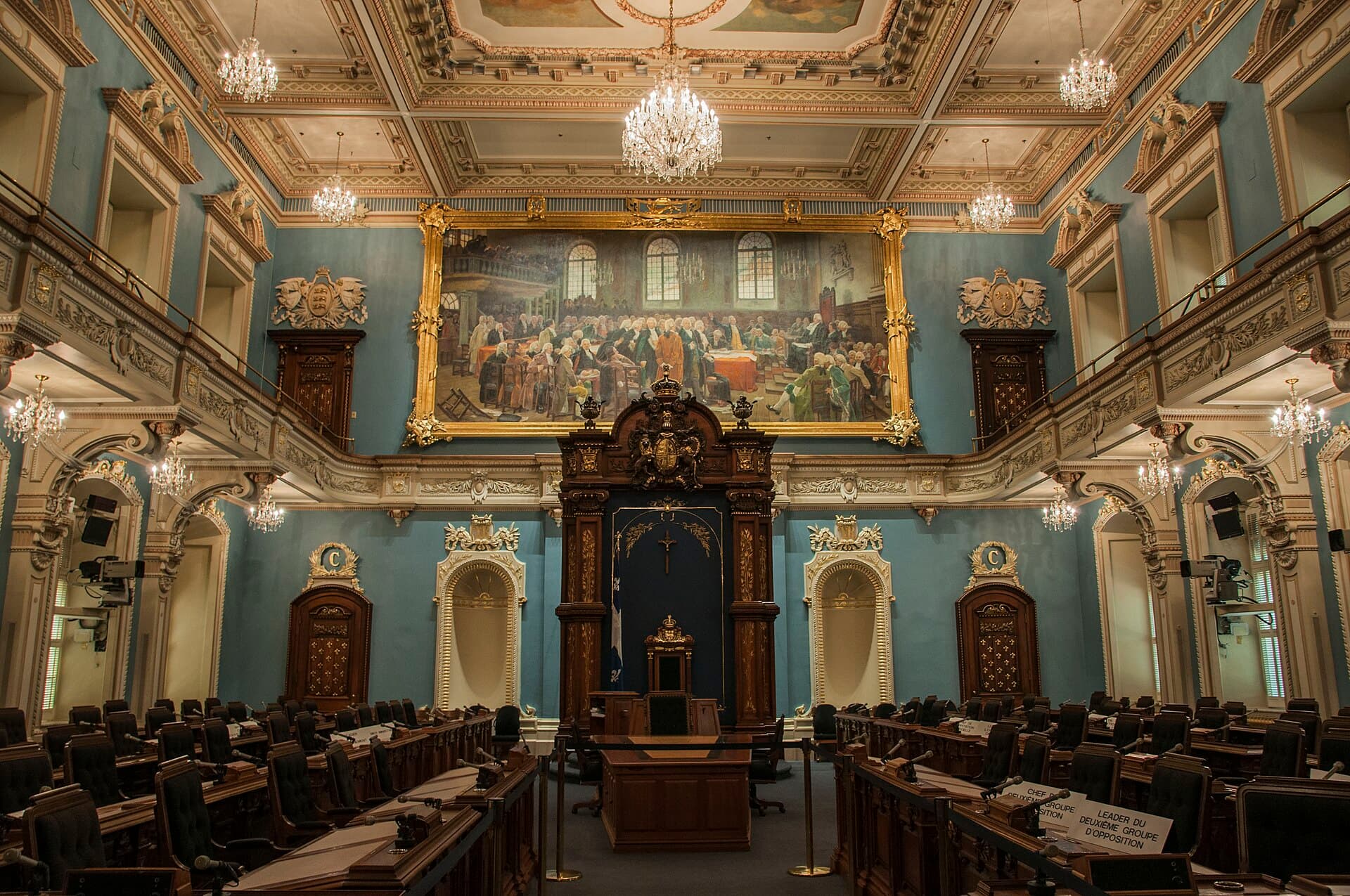
The National Assembly's return on May 5 will be the first opportunity for Fréchette to deliver a major statement of intent in legislative form. Her government's legislative timetable is expected to include a quick affordability bill, potentially packaging several measures into a single piece of legislation that can move through Salon Bleu before the summer break.
Provincial estimates for the year, the budget implementation legislation, and any tax changes tied to the cost-of-living package will follow on familiar timelines, although the new premier has signalled willingness to compress the legislative agenda if it helps deliver visible action faster.
Symbolically, Fréchette's first speech to the National Assembly as premier will draw heavy attention. Her team has been working to balance continuity messaging with enough freshness to distinguish her tenure from Legault's later years. Speeches will be analysed sentence by sentence both for substance and for tone.
Regional dimensions
Different regions of Quebec face different cost-of-living pressures. Greater Montreal has the most acute housing shortage, particularly for rental units in family-sized configurations. Quebec City has been quieter but is starting to see significant rental cost growth. Regions further from the metropolises face their own challenges, including transportation costs that make grocery prices structurally higher.
The Saguenay-Lac-Saint-Jean and Côte-Nord regions, both heavily exposed to the aluminum sector, have been watching federal-US trade negotiations with particular concern. Premier Fréchette has signalled that Quebec's voice will be active in those discussions, both because of the regional employment stakes and because aluminum is one of the province's signature exports.
The Outaouais, Eastern Townships, and Bas-Saint-Laurent each have their own mix of issues, with cost of living interacting with health-care and education service questions. The premier's office has signalled an intent to use the early weeks to do regional travel that ties cost-of-living messaging to local visits.
What's next
Fréchette's first set of legislative announcements is expected in the days surrounding the National Assembly's return on May 5. The size and composition of the affordability package, the speed at which it moves through the legislature, and the early polling response will shape the political weather for her summer.
By autumn, the broader fiscal context, including the impact of the Iran war on energy prices and inflation, will weigh heavily on the government's room to manoeuvre. The federal-provincial conversation on immigration, health-care funding, and infrastructure financing will run in parallel, with implications for Quebec's ability to deliver on its own commitments.
For Quebec voters, the early Fréchette period offers a clear opportunity to assess whether the leadership change has produced a meaningful shift in tone and substance, or whether the CAQ government continues to drift in the patterns that have eroded its standing over the past two years. The answer will probably begin to take shape over the coming weeks.
Spotted an issue with this article?
Have something to say about this story?
Write a letter to the editor