Canada's 2026 Wildfire Season Outlook Points to Uneven Risk Across the Country

Canada's 2026 wildfire season is opening under uneasy circumstances, with parts of British Columbia, Alberta, and Saskatchewan emerging from winter under abnormally dry conditions, even as eastern provinces report a more typical spring. Federal and provincial fire agencies say the early outlook points to a season with high regional variability, and they warn that lingering drought and a warm summer could tip the year toward another severe outcome after three consecutive bruising fire years.
Where conditions are most worrying
The Canadian Wildland Fire Information System, run by Natural Resources Canada, identifies the southern Interior of British Columbia, southern Alberta, and southwestern Saskatchewan as the areas where conditions most strongly resemble the early-season patterns that preceded major fire years in 2023 and 2024. Snowpack in those areas is below average, soil moisture is low, and precipitation through April has not closed the gap.
Provincial wildfire agencies in Alberta and British Columbia have already moved their fire-protection systems into seasonal staffing earlier than typical, with crews and aircraft pre-positioned in priority zones. Saskatchewan's Public Safety Agency has issued early-season advisories. Manitoba's situation is closer to average for this point in the spring, although fire managers say a hot, dry June could change that quickly.
The Yukon and parts of Northwest Territories are under closer-than-normal watching, given multi-year drought conditions in some basins. Nunavut, which historically sees less wildfire activity given vegetation and climate, faces its own pressures around tundra fires near treeline communities.
Lessons from recent years
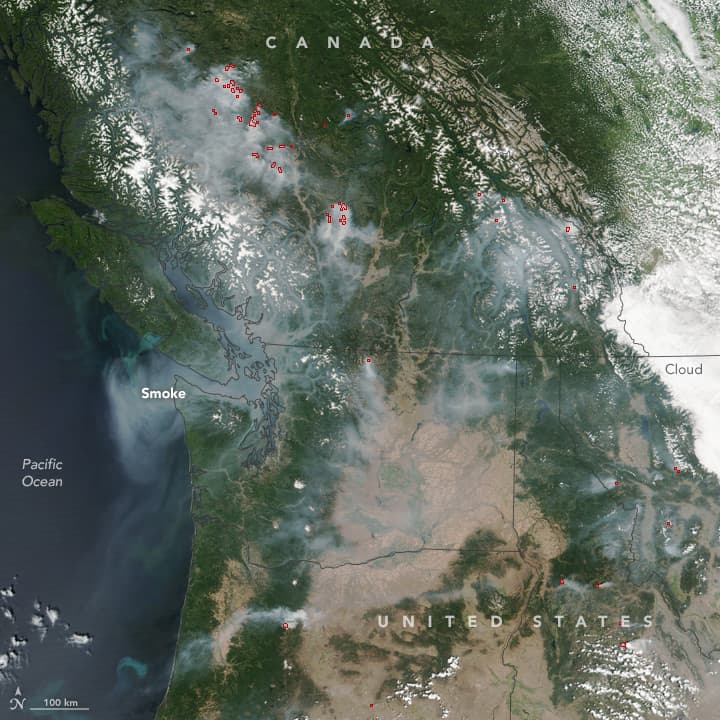
The 2023 wildfire season remains the benchmark. That year, fires burned through about 150,000 square kilometres of land, smoke from Canadian fires affected air quality across much of North America, and tens of thousands of people were displaced from their homes. The 2024 season was less severe but still well above long-term averages. The 2025 season was the second-worst on record, with significant impacts in northern Ontario, Manitoba, and Saskatchewan.
One pattern across all three years has been the early ramp-up of fire activity in May. Significant fire starts in Alberta, Saskatchewan, Manitoba, northern Ontario, and Newfoundland and Labrador in early May 2025 led to provincial states of emergency in Saskatchewan and Manitoba by month's end. Thousands of evacuees moved out of province in some cases, putting strain on hotel capacity and host communities.
That pattern is what fire managers are watching for in 2026. A few hot, windy days during the first half of May, particularly in zones where snowpack has melted but vegetation has not fully greened up, can ignite the year's most destructive blazes within hours.
Federal response
The federal government has been steadily building out its wildfire response capacity since the 2023 season, including increased aerial firefighting resources, expanded contracts with international firefighting partners such as Mexico, the United States, Australia, and South Africa, and improved coordination between Crown agencies and Indigenous fire response organisations.Public Safety Canada and the Canadian Forces have also formalised arrangements that allow military assistance to be deployed faster when provinces request it. Operation LENTUS, the Canadian Armed Forces' standing domestic disaster-response framework, was activated multiple times in 2024 and 2025, and is widely expected to be needed again this year.
The Carney government's broader interest in expanding the Armed Forces' citizen-soldier component, currently being studied by Chief of the Defence Staff Jennie Carignan, has wildfire response as one of its commonly cited justifications. A larger pool of trained, deployable personnel would reduce the strain on regular and primary reserve units that currently bear the brunt of these missions.
Provincial readiness
British Columbia entered the season with a renewed wildfire service, expanded contractor pre-positioning, and a focus on community-level FireSmart programs. The province's prevention budget has grown materially since 2023, although operational costs in extreme years still routinely overwhelm those allocations.
Alberta's wildfire agency has invested in air-tanker capacity and sustainment crews, while continuing to face challenges with the rapid pace of new development at the wildland-urban interface. Several Alberta cities, including Edmonton, Calgary, and Lethbridge, have updated their air-quality response plans after the smoke events of 2023 and 2024.
Quebec, which experienced an unprecedented fire year in 2023, has been investing in detection technology, drone-based reconnaissance, and predictive modelling. Ontario's Ministry of Natural Resources has been retooling around the same priorities, with particular attention to fires in the boreal forest north of the major population centres.
Atlantic Canada and the territories continue to operate with smaller specialised crews and external support arrangements. Yukon, Northwest Territories, and Nunavut work with federal aviation assets and southern provincial firefighters under formal mutual-aid agreements that have been activated repeatedly in recent years.
Indigenous fire stewardship
One of the more notable shifts of the past several years has been the formal recognition of Indigenous fire stewardship as a meaningful part of the response and prevention picture. First Nations and Métis fire crews now play a central role in many regions, supported by federal-provincial arrangements that fund equipment, training, and rapid deployment.
Indigenous fire managers have argued for years that traditional knowledge of fire behaviour, including the use of cultural burning to reduce fuel loads, deserves more serious integration into provincial systems. Recent fire years have given those arguments new weight, and several provinces are working through formal frameworks to bring traditional fire stewardship into the operational toolkit.
Communities in the path of severe fires have also been pushing for more local control over evacuation and response decisions. The 2023 evacuation of Yellowknife, the largest evacuation in Northwest Territories history, exposed weaknesses in coordination between federal, territorial, and Indigenous governments that have since been the subject of multiple reviews.
Health and climate context
Beyond the immediate fire risk, smoke remains a major concern. The Canadian Lung Association, Health Canada, and provincial public-health units have been refining their messaging around indoor air quality, vulnerable populations, and the importance of HEPA filtration during prolonged smoke events.
For Canadians with respiratory conditions, asthma, or cardiovascular disease, repeat exposure to wildfire smoke is associated with measurable increases in hospital visits and longer-term health impacts. Schools in many provinces have updated their outdoor activity protocols to include smoke triggers, although implementation continues to vary.
The climate dimension is unavoidable. Climate scientists and federal policy analysts have repeatedly emphasised that the current pattern of severe wildfire years is consistent with warming projections, and that the long-term trajectory points toward more frequent and more severe seasons unless and until global emissions stabilise. Carney's federal government has framed climate adaptation funding, including for wildfire response, as part of its broader Canada Strong narrative.
Insurance and economy
The economic costs of wildfire have been climbing. Insured losses from the 2023 season exceeded $1 billion, with significant uninsured losses on top. The 2024 and 2025 seasons added cumulative tens of billions in damages and disruption.
Insurance Bureau of Canada data show that wildfire and severe weather have become the dominant claims drivers in many regions, pushing premiums higher and prompting some insurers to refine coverage in fire-prone communities. Federal and provincial governments have been working with the industry on new arrangements that aim to keep coverage available while pricing risk more accurately.
Tourism, forestry, and outdoor industries in affected regions also face direct revenue losses during severe fire periods. Air travel disruption, highway closures, and park closures all carry their own economic footprint.
What's next
The next several weeks will determine whether the 2026 season tracks toward a severe outcome or a more contained one. Fire managers will be watching weather patterns, ignition counts, and the evolution of drought conditions across the prairies and the southern Interior of British Columbia.
For ordinary Canadians, the practical advice from fire and public-health agencies remains familiar. Households in fire-prone areas are encouraged to maintain defensible space around buildings, follow local fire bans, and prepare evacuation kits and plans. People with respiratory conditions are encouraged to think ahead about how they will manage during smoke events.
For governments, the decisions of the next several months, on everything from air-tanker availability to interprovincial mutual aid to Indigenous fire crew funding, will have direct consequences for how well the country weathers what could again be a long, hot summer.
Spotted an issue with this article?
Have something to say about this story?
Write a letter to the editor