Measles Spreading Across Prairie Provinces: What Families Need to Know
Canada is experiencing its most significant measles outbreak in a generation, and the Prairie provinces are among the hardest-hit jurisdictions. As of late March 2026, health authorities across the country had confirmed or identified as probable cases totalling 650 individuals across seven Canadian jurisdictions, with Alberta, Manitoba, and Saskatchewan each contributing to that figure. The broader North American outbreak of which Canada's cases form a part has approached 11,000 confirmed cases, a number that public health experts say reflects a dangerous erosion of population immunity that has been building for years.
The Scale of the Outbreak
To understand how significant the current situation is, it helps to recall that Canada was declared to have eliminated endemic measles in 1998, meaning the virus was no longer continuously circulating in the domestic population. Since then, cases have appeared periodically, almost always linked to international travel, and have occasionally caused small clusters when travellers exposed unvaccinated contacts. What is different about the 2026 outbreak is its size, geographic spread, and the evidence it provides that community immunity in some populations has fallen below the threshold needed to prevent sustained transmission.
Health authorities classify measles situations as outbreaks when there is evidence of local transmission beyond direct travel-linked cases. All three Prairie provinces have met that threshold. Alberta's case count has been the largest in the region, concentrated in several communities where vaccination rates have been lower than provincial averages. Manitoba's cases have been distributed across Winnipeg and several rural communities, with links identified to both international travel and within-community transmission. Saskatchewan's case count, while smaller in absolute terms, has included cases in First Nations communities where healthcare access and vaccination program delivery present distinct challenges.
The North American context matters because the Canadian outbreak does not exist in isolation. A major outbreak in the United States, primarily affecting communities with concentrated pockets of under-vaccination, has created an ongoing reservoir of transmission across the border. Travellers moving between Canada and the United States, and between Canada and other parts of the world where measles remains endemic, continue to introduce the virus into communities where susceptible individuals can be infected and initiate local chains of transmission.
Public health officials are tracking the outbreak in real time and working to contain it through a combination of case identification, contact tracing, and targeted vaccination campaigns. The resources required to manage an outbreak of this scale are substantial, pulling public health nurses, epidemiologists, and immunisation outreach workers away from routine work to focus on containment. The longer the outbreak continues, the greater the cumulative burden on health system capacity.
How Measles Spreads
Measles is one of the most contagious infectious diseases known. The virus spreads through the air when an infected person breathes, coughs, or sneezes, and it can remain active in the air or on surfaces for up to two hours after an infected person has left a space. In an unvaccinated population, one person with measles will infect an average of 12 to 18 others, a transmission rate that is dramatically higher than that of influenza or COVID-19 and comparable to the most contagious variants of those viruses only at their peaks.
This extraordinary contagiousness is why measles requires very high vaccination rates, around 95 percent of the population, to achieve the herd immunity that prevents outbreaks. When vaccination rates fall below that threshold in any subpopulation, the virus can find enough susceptible individuals to sustain transmission chains. The Prairie communities experiencing the most significant case counts in the current outbreak are precisely those where vaccination rates have dipped below that critical threshold.
The virus has an incubation period of 10 to 14 days from exposure to the appearance of symptoms, and infected individuals are contagious for several days before the characteristic rash appears. This means people who do not yet know they are sick are actively spreading the virus, making contact tracing challenging and increasing the likelihood that exposures occur in community settings like schools, daycares, healthcare waiting rooms, and places of worship before the index case is identified.
Children under 12 months of age, who are too young to be vaccinated under Canada's standard immunisation schedule, are among the most vulnerable individuals in the current outbreak. They depend entirely on community immunity for protection, and their vulnerability is one of the most compelling public health arguments for maintaining high vaccination rates. Pregnant women who are not immune, immunocompromised individuals who cannot receive live vaccines, and people for whom the vaccine did not generate adequate immunity are also at elevated risk.
Why the Outbreak Is Happening Now
Several converging factors explain why 2026 is seeing a measles outbreak of this magnitude. Vaccination rate declines have accumulated over the past several years, driven by a combination of pandemic-era disruption to routine immunisation programs, vaccine hesitancy movements that gained traction during the COVID-19 period, and administrative barriers to vaccination in some communities. The result is a larger pool of susceptible individuals, concentrated in specific geographic and social communities, than Canada has seen since before measles elimination was achieved.
International travel has also resumed at full volume following the COVID-19 restrictions that inadvertently suppressed measles transmission by limiting mobility. Travellers to countries where measles remains endemic, including parts of Europe, Asia, and Africa, and more recently to the United States given the large outbreak there, continue to bring the virus back to Canadian communities. The virus does not respect borders, and Canada's integration into global travel networks means imported cases will continue as long as measles circulates in any part of the world.
Social factors play a role in explaining the geographic concentration of cases. Communities where vaccine hesitancy is more prevalent, whether for religious, philosophical, or misinformation-driven reasons, create the pockets of low immunity that allow sustained outbreaks. On the Prairies, specific communities with historically lower vaccination rates have been disproportionately affected, a pattern consistent with outbreak dynamics in previous years and in other jurisdictions around the world.
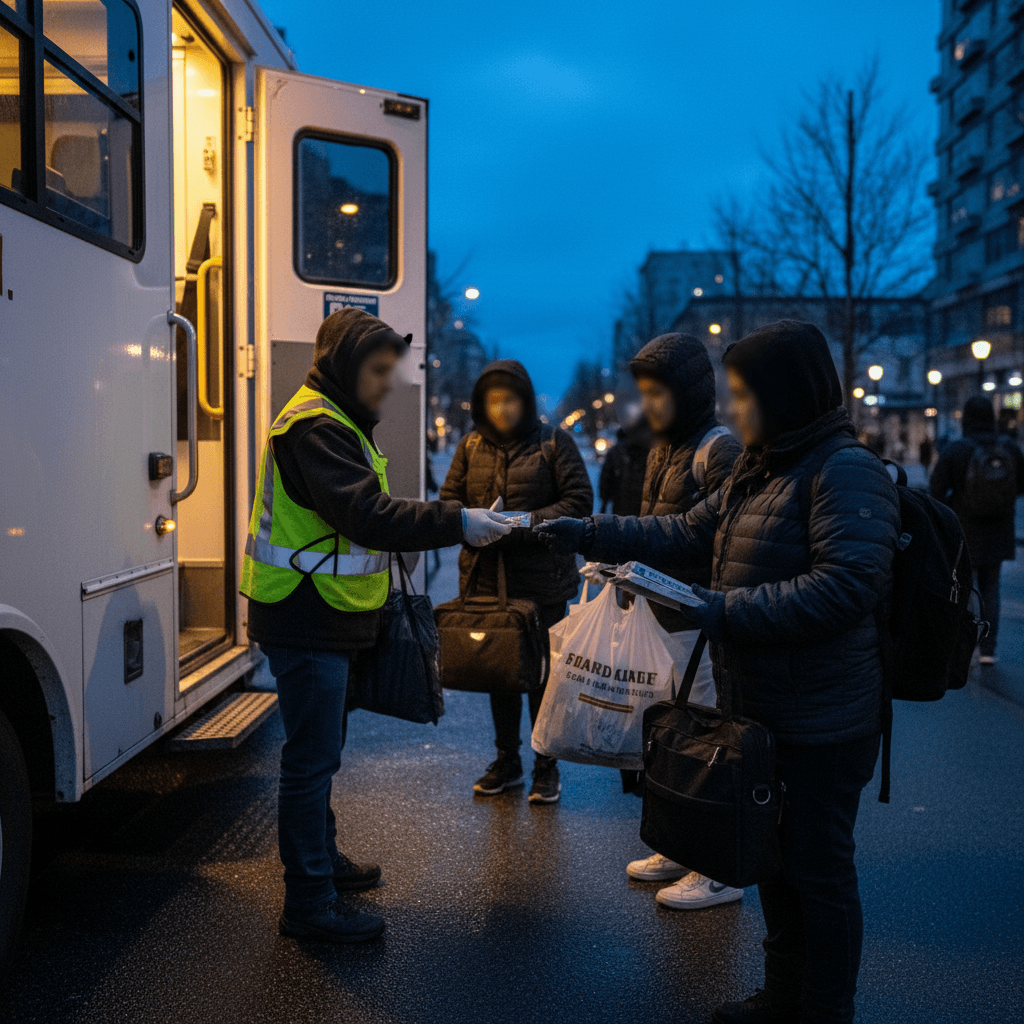
Healthcare access also contributes to vaccination coverage gaps in some Prairie communities. Remote First Nations communities, newcomer populations navigating unfamiliar healthcare systems, and low-income families without reliable transportation to vaccination clinics all face practical barriers to maintaining up-to-date immunisation. Public health agencies have been working to address these access barriers through mobile clinics and community outreach, but the pre-existing gap in coverage in some communities left them more vulnerable when the outbreak began.
Symptoms and When to Seek Care
Measles typically begins with a high fever, often above 40 degrees Celsius, along with cough, runny nose, and red, watery eyes. These symptoms appear about 10 to 12 days after exposure. A distinctive feature that appears two to three days into the illness is Koplik's spots, tiny white spots with bluish-white centres on a red background, visible inside the mouth. The characteristic red rash usually appears three to five days after the first symptoms, starting on the face and spreading down the body over several days.
In otherwise healthy children and adults, measles typically resolves within one to two weeks, though the illness is genuinely miserable during that period. The fever is high and prolonged, the cough is severe, and the child or adult is highly contagious throughout. The risk of serious complications is real: roughly one in 1,000 measles cases leads to encephalitis, inflammation of the brain that can cause permanent neurological damage or death. Pneumonia occurs in about one in 20 cases and is a leading cause of measles death, particularly in young children.
Parents who suspect their child may have measles should call their healthcare provider or provincial telehealth line before going to a clinic or emergency room. This is not bureaucratic caution: it is a critical public health step. A child with measles in a waiting room full of unvaccinated infants and immunocompromised patients could expose dozens of vulnerable individuals to the virus. Healthcare facilities ask that suspected measles cases be identified by phone in advance so they can arrange appropriate isolation and triage.
Adults who believe they may have been exposed to measles and are uncertain of their vaccination history should also contact public health or their physician. A blood test can confirm immunity status, and for those without documented immunity, a post-exposure dose of measles vaccine given within 72 hours of exposure can prevent or reduce the severity of illness. Public health authorities in all three Prairie provinces have set up dedicated phone lines to assist with this process during the outbreak.
Provincial Health Authority Guidance
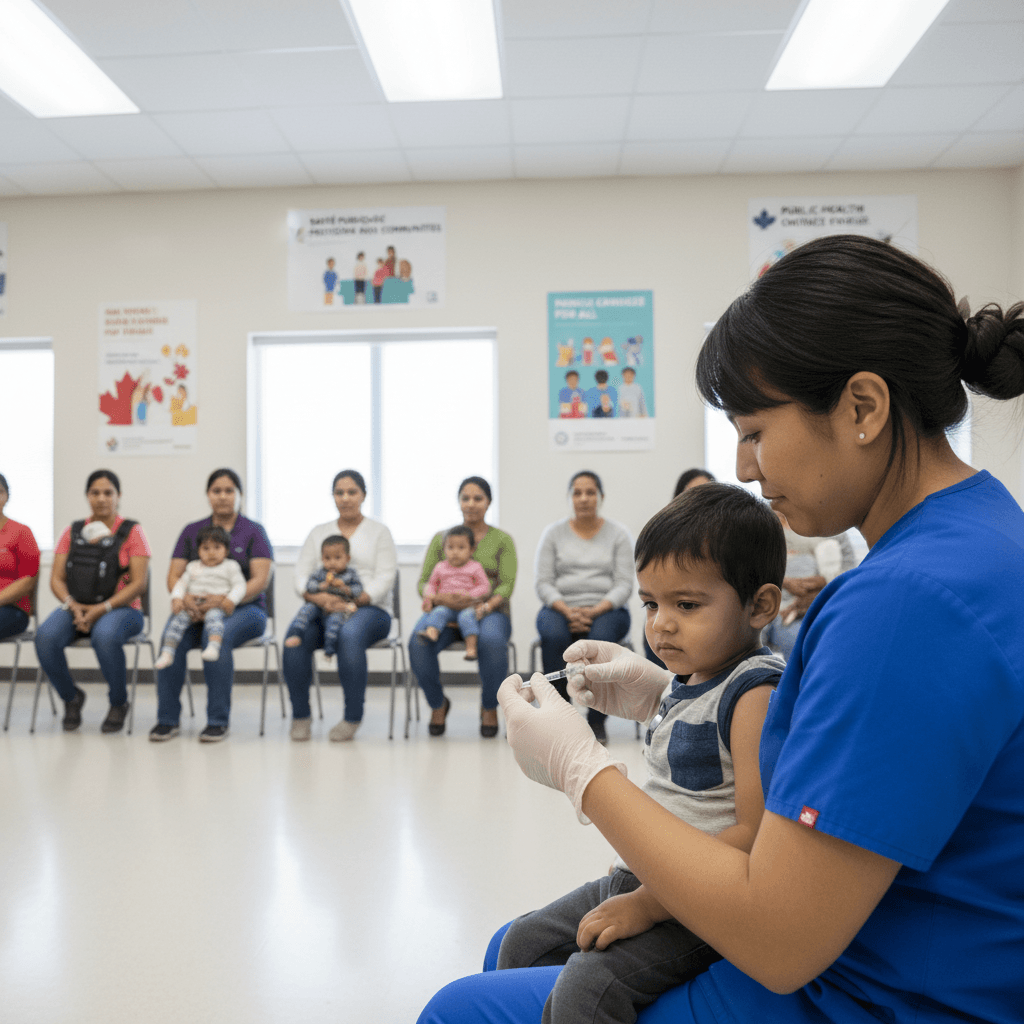
Alberta Health Services has been operating vaccination blitz clinics in communities with documented cases or elevated risk, offering measles-mumps-rubella (MMR) vaccine to anyone who does not have documented proof of immunity or two prior MMR doses. The province has urged all Albertans to check their immunisation records and contact their physician, pharmacist, or public health unit if they have any uncertainty about their vaccination status.
Manitoba's provincial public health office has issued updated guidance for schools, daycares, and congregate settings operating in areas with active transmission. Unvaccinated children in contact with confirmed cases are being excluded from school for 21 days or until they receive MMR vaccination. The province is also working with First Nations community health programs to ensure that vaccination outreach reaches communities that have historically had lower coverage.
Saskatchewan's Chief Medical Health Officer has called on all Saskatchewan residents who are unsure of their measles immunity to get vaccinated without delay. The province's immunisation registries are being actively reviewed to identify individuals or households who may have gaps in their measles vaccination history, and targeted outreach is being conducted to those individuals. Community health workers are playing a key role in delivering the message in a way that is sensitive to the specific circumstances of different communities.
All three provinces have emphasised that the MMR vaccine is safe, effective, and the only reliable way to protect against measles. The vaccine provides 97 percent protection against measles when two doses are received. It does not cause autism, a claim that has been thoroughly and repeatedly investigated and refuted, and its safety record over more than five decades of use is exceptional. Public health authorities have urged community leaders, physicians, and trusted voices in affected communities to reinforce these messages as part of outbreak response efforts.
Herd Immunity and What It Takes to End an Outbreak
Measles requires a population immunity level of approximately 95 percent to prevent sustained community transmission. At that level, the virus cannot find enough susceptible individuals to maintain transmission chains, and even when cases are imported they fade out rather than spreading. Falling below that threshold, even to 90 or 92 percent, creates a window for the kind of outbreak now being experienced across the Prairies.
Rebuilding immunity to outbreak-ending levels requires a combination of ongoing routine vaccination of new cohorts of children and catch-up vaccination of the individuals and communities where coverage has fallen. Both processes are underway, but the time required to fully close immunity gaps is measured in months, not weeks. The current outbreak is likely to continue at some level through the spring while vaccination efforts intensify.
The long-term lesson is that measles elimination requires sustained vigilance. The virus did not disappear when Canada achieved elimination status in 1998; it simply lost its foothold in a highly immune population. Allowing that immunity to erode, through complacency, misinformation, or access barriers, invites exactly the kind of resurgence now being seen. Public health officials across the Prairies are using the current outbreak as an opportunity to reinvest in the routine immunisation programs and community trust that are the foundation of measles control.
For families, the call to action is straightforward: check vaccination records, get any missing doses, and support the community vaccination clinics being offered in affected areas. Protecting children from measles requires not just individual action but collective responsibility for the community immunity that shields infants and those who cannot be vaccinated. The outbreak is serious, it is controllable, and the path to controlling it runs through vaccination.