BC United Fined for Fake Anti-Conservative Website and May Not Survive
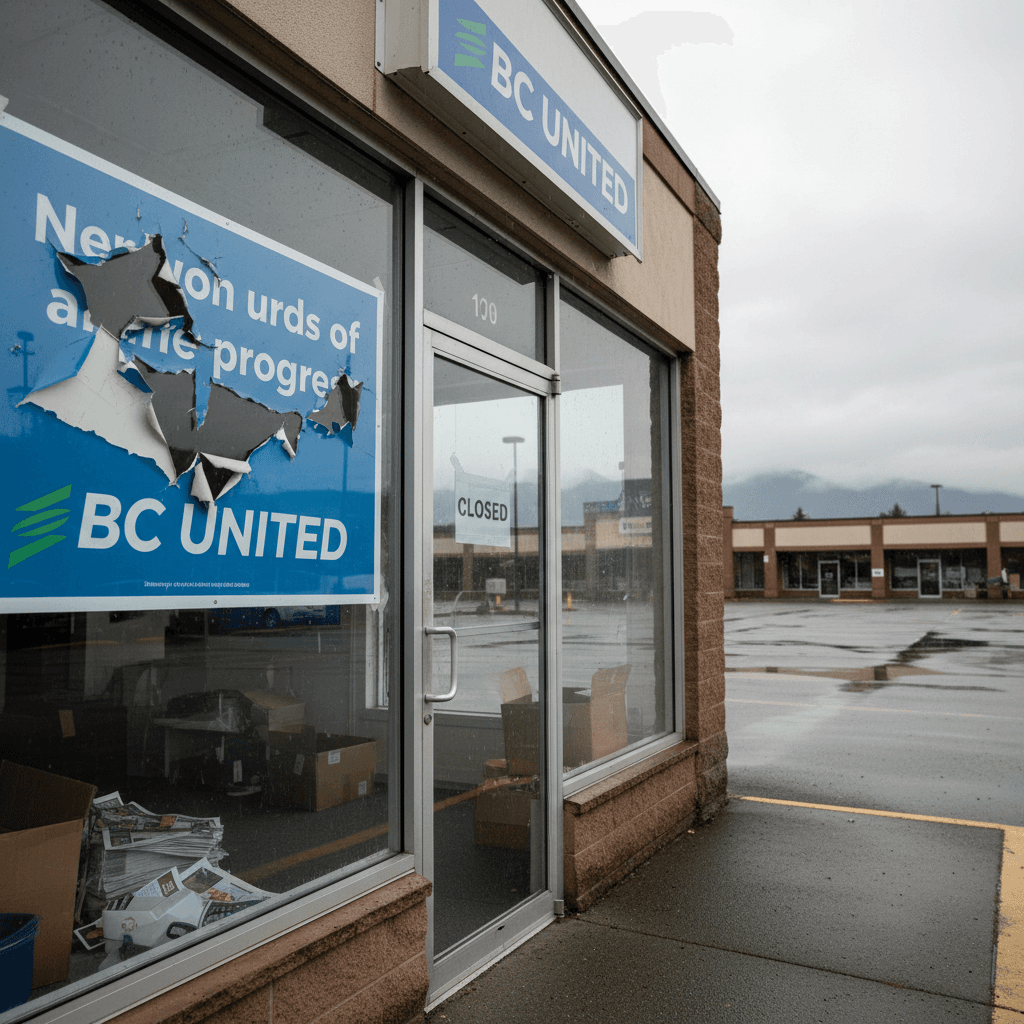
The remnants of BC United, the party that once governed British Columbia for sixteen consecutive years under the Liberal banner, have been handed a $4,500 fine by Elections BC for operating a deceptive online campaign against the Conservative Party of BC. The penalty is modest in dollar terms but devastating in symbolic weight for a party that has been effectively dormant since its collapse in the October 2024 provincial election.
The fine relates to a website operating under the domain firejohnrustad.ca, which critics and regulators said falsely presented itself as a grassroots conservative initiative while actually being run by or for BC United interests. The site was part of a broader effort to peel support away from the Conservatives during and after the election cycle. For a party still formally registered but otherwise absent from provincial political life, the citation compounds a long series of institutional embarrassments.
What the Fine Covers
Elections BC found that the firejohnrustad.ca website constituted an election advertising expense that was not properly disclosed or attributed. The site presented itself in a way designed to mislead voters about its origin, a violation of provincial campaign finance and advertising transparency rules. The $4,500 penalty is the maximum allowable under the relevant section of the Election Act for this category of offence.
The website targeted John Rustad, who led the Conservative Party of BC through the 2024 election and subsequently stepped down from the leadership, triggering the party's ongoing leadership race. The site's content framed Rustad as unfit for office and urged conservative-leaning voters to reject the party, messaging that aligned precisely with BC United's strategic interest in recovering its electoral base from the Conservatives.
Investigators reviewed advertising registrations, domain registration records and spending disclosures before concluding that the campaign violated transparency requirements. BC United's acting leadership acknowledged the ruling but did not publicly contest the findings in detail, a response that some observers read as a sign of an organization with little remaining capacity or will to mount a defence.
The Collapse of BC United
To understand why the fine lands so hard, it helps to trace how quickly BC United fell apart. The party rebranded from the BC Liberals in 2023 in a bid to shed the Liberal label, which had become a liability in a province where federal Liberal unpopularity ran deep. The rebrand was meant to reset the brand and appeal to a broader coalition of centre-right voters who had drifted toward the Conservatives.
Instead, the strategy backfired. The rebranding confused voters, failed to resolve the underlying identity crisis and gave the Conservative Party of BC under Rustad a clear lane to consolidate right-of-centre support. By the time the 2024 election was called, internal polling showed BC United hemorrhaging support, and the party's decision to withdraw candidates in several ridings midway through the campaign was widely seen as an act of institutional panic.
The final result was catastrophic. BC United won no seats and fell well below the threshold required to qualify for official party status or public funding. Leader Kevin Falcon resigned the night of the election. Several senior figures quietly joined the Conservatives or moved out of provincial politics altogether. The party's headquarters went dark, its staff dispersed, and its organizational infrastructure collapsed almost overnight.
In the eighteen months since, BC United has held no caucus, fielded no candidates in by-elections and generated no public policy presence. Its registration with Elections BC remains active, but the practical reality is that a once-dominant political force has become a legal shell with a fine and a deregistration question looming over it.
Where BC Liberal and United Voters Went
The collapse of BC United did not erase the voters it once represented. Centre-right British Columbians, business-oriented moderates, suburban homeowners worried about taxes and services, had to go somewhere. The data from 2024 and subsequent polling is fairly consistent about where they ended up.
The largest share shifted to the BC Conservatives, particularly in the Interior, the Fraser Valley and the outer suburbs of Metro Vancouver. Rustad's party ran a disciplined campaign focused on affordability, resource industries and public safety, and it was compelling enough to pull former BC Liberal voters who had never previously identified with a party further to the right.
A smaller segment moved toward the BC NDP, particularly professional and suburban voters in Greater Vancouver who prioritized stability and were alarmed by the Conservatives' positioning on social issues. Some simply stayed home. The net effect was a dramatic reshaping of the centre-right electorate that BC United had spent decades assembling.
Polling from Leger and Research Co. in early 2026 shows the NDP leading at 44% and the Conservatives at 40%, with the Greens picking up about 10%. BC United registers near zero in most surveys, suggesting its remaining brand loyalty is statistically negligible.
The Future of the Centre-Right in BC
The question now is whether BC politics has permanently consolidated into a two-party competition between the NDP and the Conservatives, or whether a revived centre-right force will eventually re-emerge to complicate that picture. Several former BC United insiders believe the latter is inevitable but acknowledge it could be a decade away.
The BC Conservative Party has been careful to position itself as a broad-tent party rather than a hard-right one, and its leadership candidates are explicitly courting former BC Liberal voters. But the party's social conservative wing, which carries real weight in rural and Interior ridings, remains a concern for fiscally conservative moderates in Metro Vancouver who remember the BC Liberal coalition as a fundamentally urban-suburban project.
There is a small movement within some BC United circles to formally wind down the party and redirect its remaining assets toward a new centrist vehicle or toward efforts to moderate the Conservative Party from within. Neither path has gained significant traction, and the Elections BC fine has not made either conversation easier to have publicly.
For the broader BC political landscape, the centre-right realignment begun in 2024 is still working itself out. The Conservative leadership race will be a critical test of whether the party can broaden its coalition without fracturing its base. That outcome will determine whether BC United's voters find a permanent home or remain a contested and potentially decisive bloc in future elections.
What the Fine Means for BC United's Registration
Under the Election Act, a party that fails to field candidates in two consecutive general elections may have its registration reviewed or revoked by Elections BC. BC United did not field a full slate in 2024 and withdrew many of its remaining candidates before election day. If the party does not reorganize and demonstrate viability before the next provincial election, expected in 2028, it faces the prospect of being deregistered.
Deregistration would extinguish whatever legal and financial assets remain, a modest sum by most accounts given the party's depleted state. It would also close any possibility, however remote, of a BC United revival. Former members who have remained formally affiliated out of habit or sentiment would have that final thread cut.
The $4,500 fine must be paid before the party can file subsequent election finance returns in good standing. Given the organization's current state, even that small administrative burden may prove difficult to resolve. Elections BC has not publicly indicated whether further complaints or investigations related to BC United's activities are pending.
The Fake Website in Context: A Broader Pattern
The firejohnrustad.ca operation did not emerge from nowhere. It reflected a broader pattern of BC United attempting to use third-party-style communications to undermine the Conservative Party without the transparency that direct party advertising would require. This approach, sometimes described in political circles as astroturfing, attempts to manufacture the appearance of organic citizen opposition while obscuring the actual organizer behind the message.
Elections BC investigators are experienced at identifying this kind of activity. Domain registration records, payment processors and advertising platform metadata often leave trails that enforcement bodies can follow when formal complaints are filed. In this case, the trail was sufficient to establish a violation and impose the maximum fine available under the applicable provision, a finding that required evidence beyond mere suspicion.
The case may have implications beyond BC United itself. It has drawn attention to the regulatory gaps in BC's campaign finance and advertising transparency laws, which some legal observers say do not adequately address the tools available to modern political operators, including social media campaigns, purchased search positioning and domain-based impersonation. A legislative review of third-party advertising rules was floated by Elections BC in 2025 and may gain renewed momentum following this ruling.
What Comes Next
Political analysts tracking BC's right-of-centre landscape say the next six months will be telling. The Conservative leadership race, which concludes with a vote among party members expected later this spring, will either produce a leader capable of consolidating former BC United supporters or risk an internal fracture that gives the NDP breathing room heading into a next election.
For the NDP government, BC United's effective disappearance has removed a strategic complication and sharpened the opposition into a single, better-defined target. Premier David Eby's team has worked to frame every provincial contest as a binary choice, a strategy that works far better against one credible opponent than against a fragmented right.
BC United, for its part, may simply fade away on its own timetable. The fine, the empty offices, the absent candidates and the departed members all point toward an organization in the last stages of institutional life. Whether it chooses a managed wind-down or simply continues to decay passively will determine how much, if any, of its legacy shapes the centre-right politics of British Columbia in the years ahead.
Related Stories
Democrats File Six Impeachment Articles Against Defence Secretary Hegseth
2h ago
French Beyond Quebec: Canada's Push for Francophone Immigration
2h ago

Ontario Sets Immigration Record: 1,334 Invitations Issued in a Single Day
2h ago

Canada's Largest Arctic War Game Just Wrapped: Inside NANOOK-NUNALIVUT 2026
2h ago