BC's Housing Math Isn't Working: Why Starts Are Falling Despite Record Need
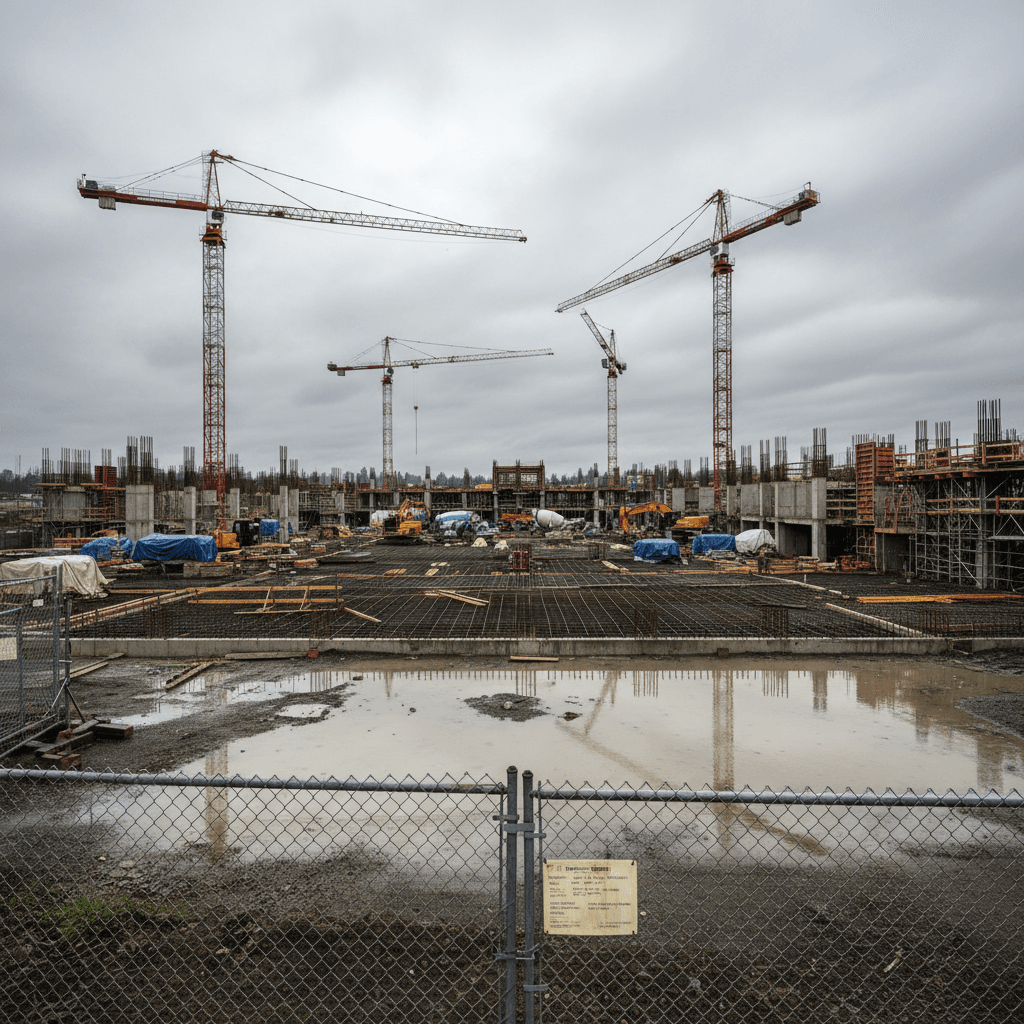
British Columbia faces a housing contradiction that no amount of political goodwill has so far managed to resolve. The need for new homes is undeniable, documented in every affordability index, visible in every encampment and felt in every household that pays more than half its income to keep a roof overhead. And yet residential construction starts are falling. Developers are shelving approved projects. Cranes that should be rising are standing still.
The explanation for this paradox sits not in a shortage of ambition or legislation but in the fundamental economics of getting a building out of the ground. Construction costs have soared. Pre-sale demand, the lifeblood of condo financing, has softened as buyers wait for prices to fall. Labour productivity in residential construction has declined for two decades. And the regulatory complexity that adds months and millions to every project has not been tamed despite years of provincial promises.
What the Numbers Show
Canada Mortgage and Housing Corporation data released in early 2026 reveals a troubling trend. Residential construction labour productivity has declined at a compound rate of 2.1% per year nationally for the past twenty years. That means it now takes significantly more worker-hours to build the same amount of housing than it did in 2006. The productivity gap has widened every year, quietly undermining every supply-side housing strategy built on the assumption that more approvals automatically translate into more homes.
In British Columbia, the productivity problem is compounded by geography and regulatory complexity. Building in Metro Vancouver requires navigating multiple layers of municipal, regional and provincial approvals, each with its own timeline and cost implications. A project that takes 24 months to permit in Calgary can take 48 months in Burnaby or New Westminster. Those extra months are not free: financing costs accumulate, market conditions change and the economic case for proceeding weakens with every passing quarter.
CMHC's most recent housing starts report for BC shows new construction activity declining in the first quarter of 2026 compared to the same period a year earlier. The decline is concentrated in the multi-unit sector, condominiums and purpose-built rental towers, which is exactly the segment that BC's affordability problem most urgently requires. Single-detached starts are also lower but represent a smaller share of the total.
The softening pre-sale market is a particular concern. Most large condo towers in BC are financed on the basis of pre-sold units, agreements from buyers to purchase a unit when construction is complete. Lenders require a minimum pre-sale threshold, typically 65 to 70% of units, before releasing construction financing. When buyers hold back, expecting prices to fall or uncertain about the economic outlook, projects stall before a shovel enters the ground.
Why Developers Are Pulling Back
Developers who spoke to media and industry associations in early 2026 pointed to a confluence of pressures that have made new projects economically unviable at current price points. Construction costs in Metro Vancouver have risen by roughly 40% over five years, driven by materials prices, labour shortages and the cumulative weight of regulatory requirements including seismic upgrading, energy efficiency standards and accessibility mandates.
At the same time, the prices buyers are willing to pay have not risen proportionately. The speculative frenzy that drove Metro Vancouver prices to extraordinary heights between 2015 and 2022 has cooled significantly. A new one-bedroom condo in Burnaby that a developer needs to sell for $750,000 to break even may find buyers who are only willing to pay $680,000, given current mortgage rates and income constraints. That gap, seemingly modest in a market where prices run into the hundreds of thousands, is enough to kill a project.
Several major developers announced project cancellations or postponements in the first quarter of 2026. Bosa Properties, Wesgroup and Concert Properties have all disclosed delays to projects that were approved and in various stages of pre-construction planning. The cancellations are geographically spread, affecting not just Vancouver but Burnaby, Surrey, Coquitlam and Langley, which were supposed to be the growth nodes for the next wave of Metro Vancouver housing supply.
Industry associations estimate that for every project cancelled at the pre-construction stage, the market loses between 100 and 400 units that will not be available for occupancy two to four years from now. Given that BC already has a cumulative housing deficit running into the hundreds of thousands of units by most estimates, each cancellation compounds a shortage that is already severe.
What the Carney Federal Fund Means for BC
The federal government under Prime Minister Mark Carney announced a $10 billion Housing Accelerator and Infrastructure Fund in the 2026 federal budget, with British Columbia expected to receive a significant allocation given the scale of its housing deficit. The fund is designed to subsidize infrastructure costs associated with new housing development, including water, sewer and transit connections that municipalities typically require developers to fund upfront.
BC housing advocates broadly welcomed the announcement but cautioned that infrastructure subsidies alone will not close the viability gap that is currently causing project cancellations. Federal money flowing to municipalities to build serviced land is helpful, but if the resulting lots still face $400-per-square-foot construction costs and softening pre-sale markets, the projects may still not pencil out for private developers.
The more consequential federal contribution, analysts say, would be direct investment in non-market and co-operative housing that does not depend on private development economics. Canada Lands Company and CMHC have land and balance sheet capacity to build rental housing at below-market rates if the political will to mobilize those resources is maintained. The Carney government has signalled interest in this approach, but the pipeline of actual projects in BC is still modest relative to the scale of need.
There is also the question of what happens when federal infrastructure dollars flow to municipalities. Metro Vancouver's regional district and its member municipalities have historically been slow to convert serviced land into entitled projects, and without changes to permitting timelines and density approvals, federal infrastructure investment can become a subsidy for existing processes rather than an accelerant for new supply.
What Provincial Legislation Has and Has Not Done
The BC NDP government has passed a significant body of housing legislation since 2023, including bills that require municipalities to permit higher densities near transit stations, remove single-family-only zoning across most of the province and restrict municipalities from blocking secondary suites and laneway houses. On paper, the legislative record is substantive.
The practical results have been mixed. Densification near transit has generated rezoning activity in some municipalities but stalled in others where infrastructure capacity, community opposition and heritage constraints have slowed implementation. The removal of single-family-only zoning has increased the theoretical supply of buildable land but has not yet translated into a wave of infill construction because the economics of small-lot infill are even more difficult than those of large condo towers.
Housing Minister Ravi Kahlon has pointed to recent data showing that purpose-built rental completions reached a multi-decade high in BC in 2025, a genuine achievement driven partly by provincial incentives including property transfer tax exemptions on new rental buildings. But completions are a lagging indicator, reflecting investment decisions made two to four years earlier. The more worrying signal is what is being approved and started today, and that picture is less encouraging.
The Rental Market and What Lower-Income British Columbians Face
While the ownership market has cooled somewhat and asking rents have declined modestly from their 2023 peak, the rental market remains brutal for lower-income British Columbians. The decline in asking rents is concentrated in newer market units and affects primarily households with the income and credit profile to compete for those units. Social and subsidized housing waitlists in Metro Vancouver run to 30,000 households or more, with average wait times of eight to twelve years for a family unit.
The provincial government's BC Builds program, which aims to deliver below-market rental units by partnering with non-profits and faith communities that own underutilized land, has generated a modest pipeline of projects. The program is popular with advocates but underfunded relative to the scale of need. A few hundred units per year does not make a meaningful dent in a waitlist measured in tens of thousands.
For minimum-wage workers, seniors on fixed incomes and people with disabilities relying on provincial income assistance, the housing market in BC remains effectively inaccessible without subsidy. Income assistance rates, which the province increased modestly in 2024, still leave recipients paying 80% or more of their monthly income on rent in Metro Vancouver even with supplements. That gap is not a housing supply problem, it is an income problem that housing policy alone cannot fix.
Indigenous British Columbians face compounding disadvantages in the housing market. On-reserve housing deficits are severe, with federal funding consistently falling short of what First Nations estimate they need to address overcrowding and deteriorating stock. Off-reserve, Indigenous people face discrimination from landlords, income barriers and the additional challenge of navigating a market where social networks and credit history play outsized roles.
What Comes Next
BC's housing crisis is not going to be resolved by any single policy intervention or market correction. The province is caught in a structural bind: the cost of building has risen faster than incomes or prices can accommodate, the regulatory system adds time and expense at every stage, and the market mechanisms that are supposed to produce supply are currently working in reverse.
The federal and provincial governments both face the choice of whether to accept the market's signal and wait for conditions to improve on their own, or to intervene more directly in the economics of construction through tax incentives, cost-sharing on infrastructure, direct public investment or some combination of all three. The evidence from jurisdictions that have expanded non-market housing supply, including Finland and Singapore and, more recently, Vienna, is that direct public investment is the most reliable lever for ensuring affordability at the lower end of the market.
For British Columbians waiting for relief, the most honest assessment of the current situation is that market rental affordability has improved marginally at the top of the market while conditions at the bottom have not changed meaningfully. Building more market condos will eventually filter down to lower price points, but the filtering process in a market as supply-constrained and expensive as Metro Vancouver takes decades, not years. The households that need help now will be waiting a very long time if that is the primary strategy.
Related Stories

IMF Cuts 2026 Growth Forecast to 2.5%: What It Means for Canada
1h ago
Manitoba Raises Minimum Wage to $16.40 and Opens New Brandon Health Centre
1h ago
Ontario Line Tunnelling Begins: Toronto's Biggest Transit Build in Decades
1h ago

Nunavut Gets Fuel Tax Relief — But Groceries Still Cost 50 Per Cent More Than Ottawa
1h ago