Four Candidates, One Party to Rebuild: The BC Conservative Leadership Race
When John Rustad stepped down as leader of the Conservative Party of BC following the 2024 provincial election, he left behind an organization that had just achieved something no one fully predicted: official opposition status in Victoria and more than 40% of the popular vote in a province the right had not seriously contended since the BC Liberals' era. The question now is who picks up that momentum and what they intend to do with it.
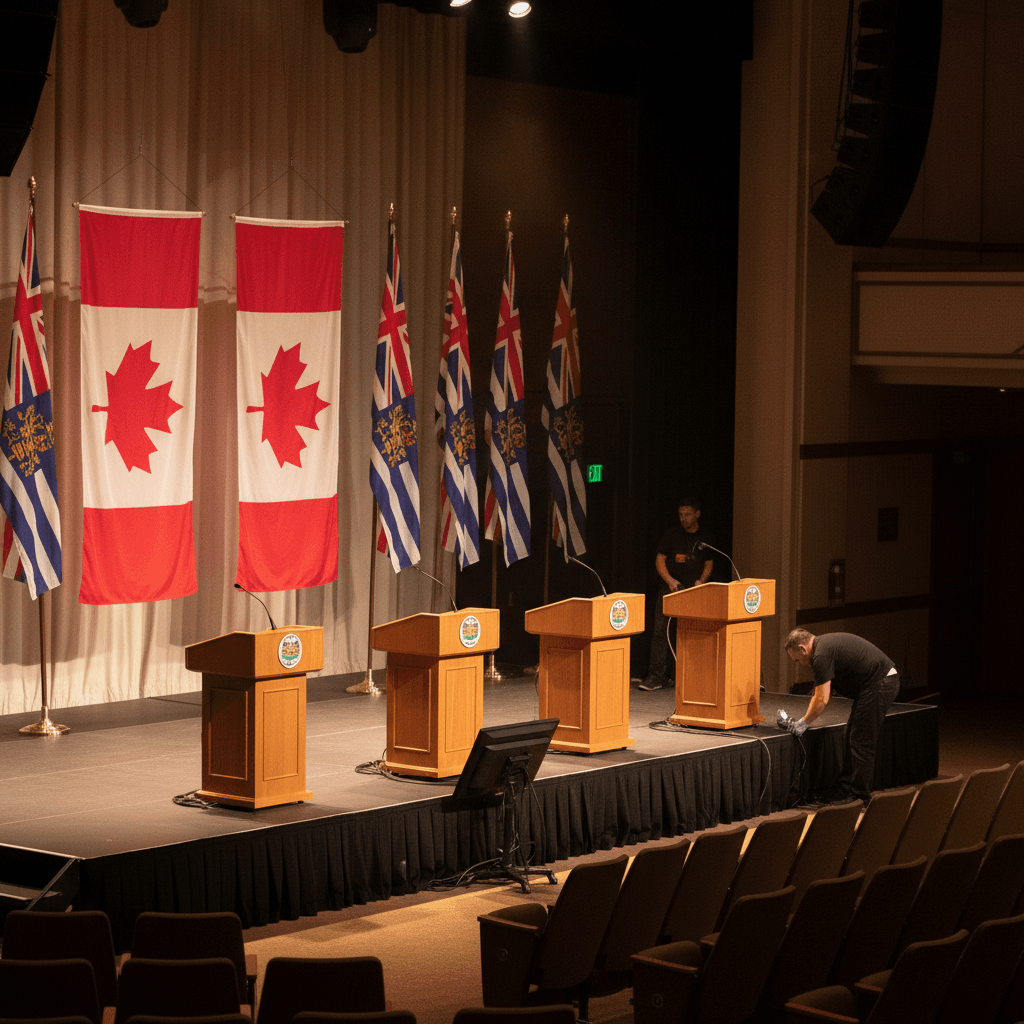
Four candidates appeared on stage for the party's first leadership debate on April 8, 2026, each arguing they represent the best path from official opposition to government. The race is the most consequential contest in BC conservative politics in a generation, and the outcome will shape the province's political landscape heading into the next election, expected in 2028.
The Four Candidates
The field brings together a mix of provincial and municipal political experience. Gavin Dew, a Vancouver businessman and former Vancouver city council candidate with strong ties to the party's economic wing, has built his campaign around affordability and fiscal discipline. He is widely seen as the candidate most likely to appeal to former BC Liberal voters in Metro Vancouver, and he has positioned himself explicitly as a big-tent leader capable of attracting suburban centrists.
Elenore Sturko, a Surrey MLA and former RCMP officer, has anchored her campaign on public safety and family-focused social policy. Sturko won her seat in 2024 and brings credibility as a sitting legislator. Her background resonates in Fraser Valley and suburban ridings where crime, policing and community safety consistently rank among the top voter concerns. She has been careful to project a moderate tone on social issues while maintaining clear law-and-order commitments.
Dallas Brodie, a Vancouver city councillor and former academic, represents the party's more libertarian strand. Her campaign emphasizes individual freedoms, reduced government intervention and a sharp critique of what she describes as an overreaching regulatory state. Brodie has a dedicated following among party members who believe the Conservatives need to present a philosophically distinct alternative to the NDP rather than a centre-right version of managerial governance.
Phil Hochstein, a longtime voice for the independent business and construction sectors, brings deep roots in BC's small and medium enterprise community. His pitch centres on cutting red tape, reducing costs for employers and restoring competitiveness to a provincial economy he argues has been strangled by NDP regulation over six years in government. Hochstein is less well known to the general public but commands respect within industry circles that fund and organize a significant share of the province's centre-right political infrastructure.
The Policy Debate
The April 8 debate surfaced genuine disagreements about direction alongside the predictable areas of consensus. All four candidates criticised the NDP's housing record, opposed the carbon pricing framework and pledged to reduce the provincial debt load. The contrasts emerged when questions shifted to social policy, resource industries and the role of the federal Conservative government in shaping BC's political identity.
On the resource economy, Hochstein and Dew pushed the hardest for an aggressive expansion of natural gas, mining and forestry activity, framing resource development as the engine of the province's economic recovery. Sturko offered a more conditional endorsement, tying resource expansion to Indigenous consultation and environmental assessment reform. Brodie went furthest in arguing for regulatory rollback, proposing to streamline permitting timelines to a fraction of their current length.
Affordability generated the most heat. Dew's housing platform called for a series of supply-side interventions including upzoning, infrastructure cost reform and a crackdown on municipal delays. Sturko emphasized homeownership incentives for working families. Hochstein tied housing affordability directly to construction industry costs, arguing that labour rules and materials prices need to be addressed at the source rather than through demand subsidies.
The social issues question, always delicate for a party trying to hold together urban moderates and rural social conservatives, was handled carefully by all four. None of the candidates proposed reopening the abortion debate or reversing the province's SOGI 123 school curriculum in explicit terms, though Brodie and Hochstein signalled more openness to parental rights arguments that have gained traction in some communities.
What the Party Needs to Become Government
The 2024 result was genuinely remarkable. Rustad's Conservatives came within a few seats of forming government against a sitting NDP government running during a cost-of-living crisis, and they did so while absorbing a flood of former BC United supporters who had never previously voted Conservative. The near-win demonstrated that a coalition of the right was possible.
What it also showed is that winning Metro Vancouver ridings, or at minimum not getting shut out of them, is essential to any majority path. The Conservatives won dramatically in the Interior and Fraser Valley but struggled to convert support in Burnaby, Richmond, North Vancouver and the Vancouver suburbs that routinely decide BC elections. The new leader will need a credible story for urban voters.
Party insiders describe two broad strategic visions competing within the leadership race. One sees the path to government running through the consolidation of centre-right voters in suburban Vancouver by moderating the party's image on social issues and prioritizing economic bread-and-butter messaging. The other believes the party should mobilize its rural and exurban base more intensively and compete for working-class NDP voters disaffected by affordability failures.
Neither vision is obviously wrong, and both have historical precedent in Canadian provincial politics. The question is which candidate can execute one credibly enough to unseat a government that, despite real political vulnerability, still leads in every public poll.
How BC Conservatives Differ from Federal Conservatives
One recurring theme in the leadership race is the relationship between the provincial Conservative Party and Pierre Poilievre's federal party. The BC Conservatives are a separate entity with their own constitution and membership, but the two organizations share a brand, a donor base and a significant overlap in personnel.
All four candidates have been careful to maintain some degree of independence from Ottawa's messaging, particularly on cultural issues where federal Conservative positions have generated controversy in urban British Columbia. Dew has been most explicit about this, arguing that provincial conservatism in BC must be rooted in BC's specific economic and demographic realities rather than imported from an Alberta or Prairie template.
The distinction matters because a significant portion of potential Conservative voters in Metro Vancouver are economically conservative but socially moderate, people who supported the BC Liberals for decades and are now evaluating whether the BC Conservatives represent a comfortable fit. Federal Conservative positions on issues like access to abortion services, LGBT rights and immigration have created headwinds in exactly those communities.
Party strategists acknowledge the tension but note that the federal Conservatives' strong showing in BC in recent elections suggests the brand damage is manageable if the provincial party stays focused on local issues. The new leader will need to navigate that relationship with some care.
The Lesson from the 2024 Near-Win
Rustad's leadership produced the strongest Conservative result in BC in decades, but it also exposed limitations. The party's late-campaign surge stalled partly because some voters who had been open to change ultimately hesitated over concerns about specific candidates, about the party's organizational readiness for government and about risks on social policy.
Party insiders say the new leader must address all three dimensions. Candidate quality and diversity, particularly in ridings that require credible local champions rather than parachute nominations, need improvement. The party's policy platform needs to be detailed enough to satisfy scrutiny from journalists and voters who will ask what a Conservative government would actually do about housing, health care and the cost of living.
Rustad himself, who departed with considerable goodwill within the party, has stayed largely out of the leadership contest publicly. His absence from active endorsement has left the field relatively open and avoided a dynamic where the race becomes a proxy battle over his legacy.
Health Care and the Conservative Alternative
One policy area that received meaningful attention during the April 8 debate was health care, a file where the NDP government has faced sustained criticism and where the Conservatives see genuine electoral opportunity. All four candidates criticized the government's handling of health human resources, pointing to persistent family doctor shortages, emergency room closures and long wait times for specialist care that affect communities across the province.
Dew proposed expanding the role of private delivery within the publicly funded system, drawing on the experience of other provinces that have used contracted surgical centres to clear backlogs without creating a two-tier system based on ability to pay. Sturko emphasized recruitment and retention incentives for nurses and physicians, arguing that the workforce crisis is fundamentally a compensation and working conditions problem that cannot be solved through structural reform alone.
Brodie went furthest in proposing deregulation of health care delivery, arguing that scope-of-practice restrictions on pharmacists, nurse practitioners and physiotherapists are costing British Columbians access to care they could receive safely and affordably if regulatory barriers were reduced. Hochstein focused on administrative costs within the health care system, arguing that the merger of regional health authorities has produced layers of bureaucracy that consume resources without improving front-line care.
The health care debate is important because it is one of the few files where the Conservatives have to demonstrate they have a credible plan rather than simply an indictment of the NDP record. Voters who are unhappy with the current government still need to trust that the alternative will not make things worse, a threshold the party's 2024 platform did not fully clear for all undecided voters.
What Comes Next
Party members will cast ballots in the leadership vote expected before the end of spring 2026. The winner inherits a well-funded organization, a motivated activist base and an opposition caucus in Victoria with enough seats to be genuinely disruptive. They also inherit the challenge of consolidating a coalition that formed quickly and could fracture if the party misreads its mandate.
The NDP government, tracking the race closely, believes Dew poses the greatest threat in Metro Vancouver while Sturko is best positioned to hold Interior and suburban gains. Government strategists are preparing for a campaign that will begin in earnest the moment a new Conservative leader is confirmed.
For British Columbians watching from the outside, the leadership race is a referendum on what the province's right-of-centre movement believes it is and where it wants to go. The 2024 near-win proved the coalition was possible. The 2028 election will test whether the new leader can close the deal.