Housing Crisis Deepens: CMHC Warns Starts Will Fall Through 2028
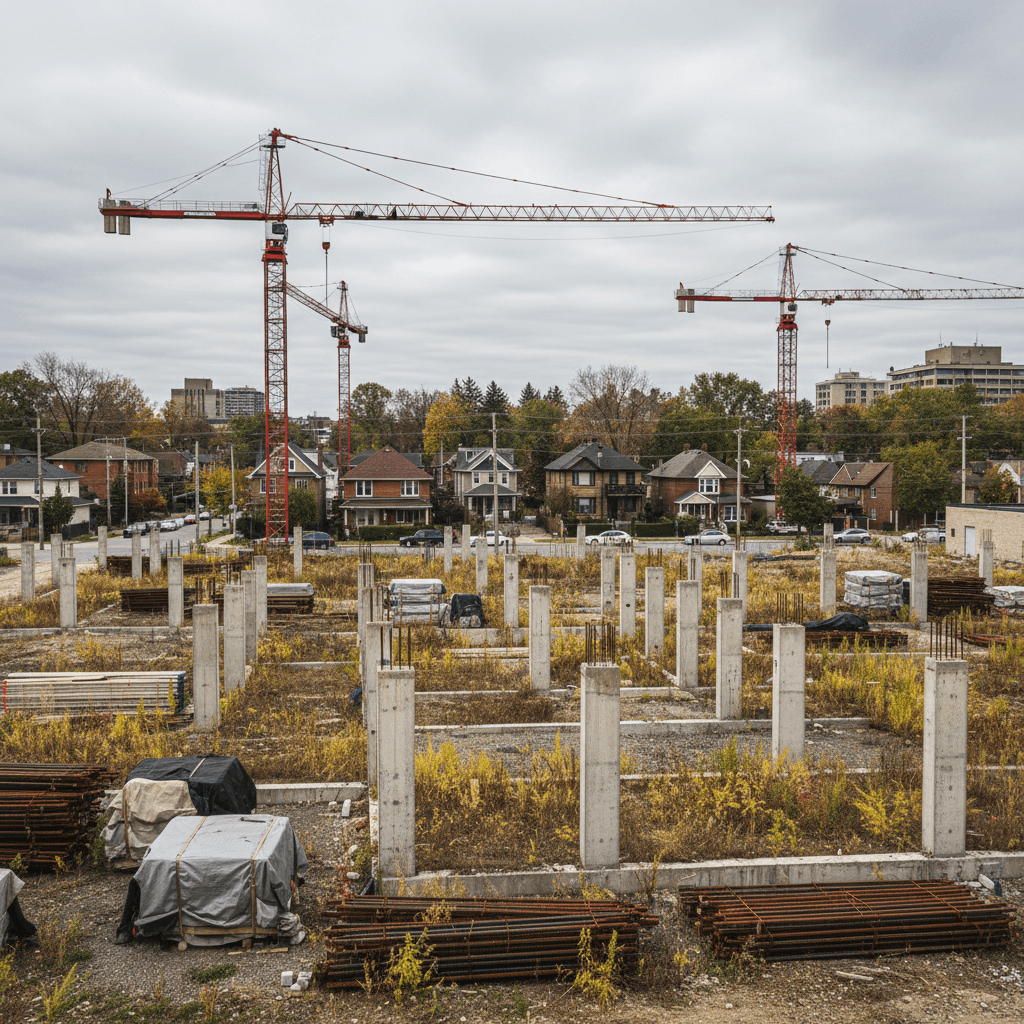
Canada's housing crisis, already among the most severe of any developed nation relative to population and income, is entering a new and more troubling phase. A new study from the Canada Mortgage and Housing Corporation released in April 2026 documents a twenty-year decline in residential construction labour productivity, averaging 2.1 per cent per year, that has quietly eroded the country's capacity to build homes even during periods of high nominal activity. Layered on top of this structural deterioration, CMHC's Spring 2026 forecast projects that housing starts will decline through the next three years as developers respond to softening demand, elevated material and labour costs, and financing conditions that make many projects financially unviable.
The Productivity Crisis Nobody Talked About
The housing conversation in Canada has focused heavily on demand-side factors: immigration, investor activity, short-term rentals, and the role of the Bank of Canada's interest rate decisions. The CMHC productivity study forces a reckoning with the supply side in a way that goes beyond simple narratives about zoning reform and NIMBYism. Even if every municipality in Canada rezoned tomorrow and approved every project in its pipeline, the construction sector would be physically incapable of building homes at the rate required without addressing a fundamental productivity problem.
The 2.1 per cent annual decline in residential construction labour productivity means that it now takes roughly one and a half times as many labour hours to build the same home as it did twenty years ago. The causes are multiple and interconnected. The workforce has aged significantly, with fewer young workers entering the trades. Adoption of prefabricated and modular construction methods, which have transformed housing production in Scandinavia, Japan, and parts of Germany, has been slow in Canada. Regulatory complexity at the municipal level has extended the time between project approval and first pour, inflating carrying costs. And the fragmented structure of the Canadian residential construction industry, dominated by small and medium builders rather than large-scale developers with capital to invest in productivity technology, has limited the pace of innovation.
The CMHC study also notes that Canada's construction sector has been less successful than its international peers at incorporating digital project management tools, building information modelling software, and lean construction methodologies. These are not futuristic technologies; they are widely deployed in comparable markets. Their absence in Canadian residential construction is partly a training and education gap and partly a capital investment gap that the fragmented industry structure makes hard to bridge.
The Developer Cancellation Wave
Against the backdrop of the structural productivity problem, CMHC's Spring 2026 forecast documents an accelerating wave of project cancellations and deferrals that is reducing the near-term pipeline of homes that will actually be built. The cancellations are concentrated in the condo presale market in Toronto and Vancouver, where the financing model requires developers to sell a minimum percentage of units before construction lenders will advance capital.
That presale threshold has become increasingly difficult to meet as buyer psychology has shifted. The combination of economic uncertainty related to U.S. trade tensions, elevated mortgage rates relative to the recent historical low point, and a general expectation among some buyers that prices may soften further has pushed presale absorption rates down significantly. Developers who launched projects in 2024 expecting to hit presale targets by mid-2025 have instead watched their sales pace slow, triggering lender reviews and, in some cases, outright cancellation of financing commitments.
The Bank of Canada's decision to hold its overnight rate at 2.25 per cent at its April 2026 meeting reflects an economy where inflation, at 1.8 per cent, is under control and unemployment, at 6.7 per cent, is modestly elevated but not alarming. Those headline numbers do not capture the specific stress in the housing construction financing market, where project-level viability calculations are more sensitive to cost inputs than to the policy rate itself. A 2.25 per cent overnight rate with elevated construction costs and soft presales still produces project economics that do not pencil out for many developers.
Industry associations are reporting that project deferrals are concentrated in the 500-to-800 unit condo tower segment that has been the primary driver of density in Toronto and Vancouver. Smaller infill projects, missing middle housing, and purpose-built rental are relatively less affected because they involve different financing models and different cost structures. But the tower segment represents an enormous share of the total pipeline, and its contraction means the units needed to house the people arriving in Canadian cities will not be available when they are needed.
Affordability Math: How Bad Is It
The CMHC productivity and forecast data has to be understood against the broader affordability context. Canada's benchmark home price, at roughly $720,000 nationally as of March 2026, represents approximately eleven times the median household income, one of the worst ratios among OECD countries. In Toronto and Vancouver, the ratios are far worse: fourteen to sixteen times median income for ownership, with rental costs consuming more than 40 per cent of median after-tax income for renter households in those cities.
The standard definition of housing affordability is that shelter costs should consume no more than 30 per cent of gross income. For median-income renter households in Toronto and Vancouver, even the most modest market-rate rental accommodation exceeds this threshold by a wide margin. The consequence is a growing share of income being diverted from consumption, savings, and investment toward housing costs, with downstream effects on household financial resilience, fertility rates, and geographic mobility.
If housing starts decline through 2028 as CMHC projects, the affordability situation will worsen even further. The supply of available units will shrink relative to population growth, even accounting for some moderation in immigration volumes. Vacancy rates in major centres, already below one per cent in many submarkets, will tighten further. And the rental housing that does exist will face intense competition, keeping rents elevated even in a period of general economic softness.
What the Carney Government Can Do
The federal government's toolkit for addressing housing supply is real but constrained by constitutional reality. Housing is primarily a provincial and municipal matter. Ottawa can provide funding, create financial incentives, set national targets, and use its regulatory influence over mortgage lending and CMHC to shape market conditions. But it cannot directly build homes at scale without either partnering extensively with provinces and municipalities or creating a federal housing development capacity that does not currently exist.
On the productivity problem specifically, the federal government has several potential levers. Expanding the Building Trades apprenticeship funding programs to accelerate the training of construction workers is one. Creating federal incentives for modular and prefabricated construction technology adoption, including procurement commitments for federal and federally funded building projects, is another. The National Research Council has a role to play in developing and diffusing productivity-improving construction standards that could be adopted provincially.
On project viability, the government's housing finance tools are more immediately useful. CMHC's Apartment Construction Loan Program, which provides low-cost financing for purpose-built rental construction, has been expanded several times and represents a direct intervention in the project economics problem. Extending and deepening this program, particularly for projects in secondary cities where the presale model is less viable, could prevent some portion of the projected start decline from materialising.
The Housing Accelerator Fund, which provides direct grants to municipalities that adopt specific zoning and permitting reforms, is another lever. The program has already generated commitments to zoning changes in dozens of cities. Converting those commitments to actual permits and then to actual builds takes time, but the pipeline of reform is at least now in motion in ways it was not five years ago.
The Secondary Cities Question
One underappreciated dimension of the CMHC forecast is its geographic distribution. The start decline is projected to be most severe in Toronto and Vancouver, the two markets where the presale condo model is most dominant and where project economics have deteriorated most sharply. Secondary cities such as Calgary, Edmonton, Halifax, and Kitchener-Waterloo are projected to fare better, with some continuing moderate growth in starts driven by relatively lower land costs and stronger relative affordability.
This divergence has implications for federal housing policy. If significant population is willing to relocate from primary to secondary cities in response to affordability signals, which is exactly what the data on Toronto's out-migration suggest, then supporting infrastructure and services in those secondary cities becomes a housing strategy in itself. A family that moves from Toronto to Hamilton or from Vancouver to Kelowna because housing is accessible there is effectively solving their own housing problem without requiring a new unit to be built in the most constrained markets.
The federal government's commitment to infrastructure funding in secondary cities through the Build Communities Strong Fund is therefore also a housing policy, even if it is not labelled as such. Transit, schools, health facilities, and broadband in secondary centres make them more viable destinations for families and workers seeking more affordable lives. The connection between community infrastructure investment and housing market distribution is one of the more nuanced aspects of the current federal strategy.
What the Next Three Years Look Like
CMHC's projection of declining starts through 2028 is a forecast, not a certainty. The variables that could improve the picture include a faster-than-expected resolution of U.S.-Canada trade tensions that restores consumer and developer confidence, a Bank of Canada rate cut cycle that improves mortgage qualification and project financing, faster adoption of productivity-improving construction methods, and accelerated delivery of federal housing finance incentives.
The variables that could make the picture worse include a global economic slowdown that further dampens demand, a construction labour shortage exacerbated by an aging workforce retiring faster than it is being replaced, escalating material costs linked to global supply chain disruptions, and municipal resistance to the densification conditions attached to federal infrastructure funding. The housing file in Canada has rarely broken cleanly toward the optimistic scenario. Addressing it requires sustained political will, policy coordination across three levels of government, and a construction sector transformation that has been needed for two decades and has not yet begun in earnest.