Pentagon Freezes Defence Forum, Pressuring Ottawa on Spending
The United States has frozen its participation in the oldest formal channel for North American continental defence, opening one of the sharpest ruptures in the Canada-U.S. military relationship in decades and pressing Prime Minister Mark Carney's government to spell out how it will spend far more on defence. The Pentagon announced on 18 May 2026 that it was pausing its role in the Permanent Joint Board on Defense, the senior advisory body established in 1940 by Franklin Roosevelt and William Lyon Mackenzie King to coordinate the continent's defence. A pause is without precedent in the board's history, and it landed in Ottawa as a deliberate signal, not a routine scheduling matter.
Blunt public criticism followed. On 21 May, a senior U.S. defence official said Canada is falling short on defence spending and pointed to the slow pace of its review of the F-35 fighter purchase, under way for more than a year. The official said Canada has yet to articulate a credible path to NATO's new targets, and described reaching roughly 3.5 per cent of gross domestic product on core defence by 2035 as a reasonable place to start. The message: commitments are no longer enough, and Washington now wants a resourced plan with dates and dollars attached.
For Canada, the stakes are unusually direct. The dispute touches sovereignty, the security of the Arctic and the continental approaches, tens of thousands of aerospace jobs tied to the fighter decision, and the shape of the federal budget for the next decade. It also accelerates a question Ottawa has circled for more than a year: whether to hedge against an unpredictable Washington by deepening defence ties with Europe. A quarrel over an advisory board has, in effect, become a test of Canada's place in the Western alliance.
An 86-Year-Old Board Goes Silent
The Permanent Joint Board on Defense has never carried operational authority. It is an advisory forum where senior military officers and civilian officials from both countries meet twice a year to study shared threats and offer policy advice. Its value has always been symbolic and practical at once, a standing reminder that North American defence is a joint enterprise and a venue to work through sensitive questions away from public view. That it has run uninterrupted since the Second World War is part of what made the pause so striking.
The Pentagon framed the decision as a reassessment of how the forum benefits shared North American defence, tying it explicitly to frustration with the pace of Canadian commitments. A senior U.S. defence official pointed to public remarks by Carney earlier in the year as evidence, in Washington's reading, that Ottawa was not treating the spending question with sufficient urgency. The framing left little doubt the freeze was meant to be felt.
It is important to separate what has changed from what has not. NORAD, the binational aerospace and maritime warning command headquartered in Colorado Springs, is governed by a separate treaty and is not affected by the pause; the U.S. official stressed the freeze does not touch NORAD operations. What has been suspended is the senior advisory layer above that machinery, where strategy is debated rather than executed. Even so, the symbolism cuts deep. Canadian analysts warn that silencing the most senior consultative channel removes a pressure valve just as tensions rise.
What Washington Is Demanding
The substance of the U.S. complaint is spending, and the benchmark has shifted dramatically. Canada reached NATO's longstanding target of 2 per cent of GDP on defence in 2025, spending more than $60 billion, a milestone that took years to reach. But the alliance has since moved the goalposts, agreeing to a far higher benchmark of 5 per cent of GDP by 2035, commonly framed as 3.5 per cent for core military spending plus 1.5 per cent for related infrastructure. Carney has committed Canada to that goal.
The gap between commitment and credible plan is what Washington is now exploiting. The U.S. official said a plan with resourced investments that would put Canada on pace to spend 3.5 per cent on core defence by 2035 would be a good place to start, treating the higher figure not as the finish line but as the opening expectation. For a country that strained to reach 2 per cent, that path implies budget increases that would reshape federal finances and force trade-offs against priorities from health transfers to housing to the government's energy agenda.
On 23 May it was reported that the Pentagon had handed Canada a classified paper detailing American defence priorities and expectations. The existence and contents of such a document have not been confirmed in public, and the detail should be treated with caution. If accurate, it would suggest Washington is moving from public pressure to a more formal articulation of what it wants, narrowing the space for Canada to define the relationship on its own terms.
The F-35 Decision in Limbo
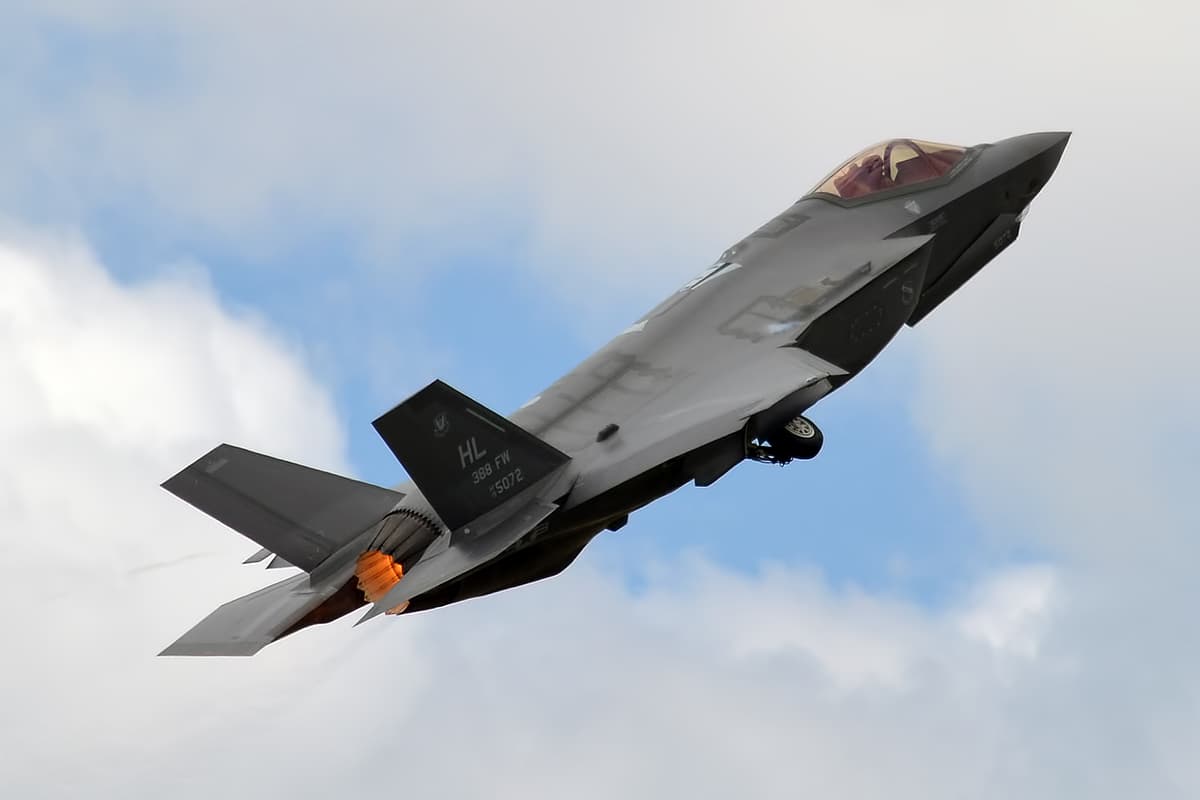
No single file better captures the bind than the F-35. Canada ordered 88 of the Lockheed Martin stealth fighters in 2023 to replace its ageing CF-18 fleet, then began reassessing the purchase after Donald Trump returned to the White House, a review now running more than a year. The military assessment was reportedly completed quickly. What has kept the file in limbo is the question of industrial benefits and whether part of the buy could shift to an alternative such as the Swedish-built Gripen, anchoring more work in Canada.
The Pentagon has seized on that delay as foot-dragging, reading hesitation over a flagship American platform as a lack of seriousness about interoperability. From Ottawa's perspective, the review is a legitimate effort to weigh sovereignty, supply-chain security and the domestic economic return of a multibillion-dollar procurement at a time when relations with Washington have grown unpredictable.
The jobs dimension is central to the Canadian calculation. Aerospace is one of the country's most significant advanced-manufacturing sectors, and the structure of the purchase shapes how much work, from components to maintenance, lands in Canadian plants across Quebec, Ontario and beyond. There is also a harder strategic worry: relying on a single supplier for a frontline fighter concentrates risk, raising questions about sustainment, software updates and spare parts should Washington ever apply leverage, a concern that looks more pressing after a freeze on the defence board.
Sovereignty and the Arctic
Continental defence is not an abstraction for Canada. The country's vast northern frontier, its Arctic archipelago and the air and sea approaches over the pole are the geography the Permanent Joint Board on Defense was created to help protect. As polar ice retreats and great-power competition extends into the Arctic, the security of that region has moved up the agenda in both Ottawa and Washington, making the timing of the freeze all the more pointed.
The dispute exposes a long-standing tension. Canada depends heavily on the United States for the umbrella of continental defence, yet guards its sovereignty over Arctic waters and airspace, including disputes over the status of the Northwest Passage. A more transactional Washington willing to suspend cooperation as leverage forces Ottawa to confront how much of its security rests on a partner whose reliability it can no longer take for granted.
Investment in the North is one obvious answer, and it overlaps with the spending demand. Upgrading northern radar and surveillance, expanding Arctic infrastructure and strengthening the Canadian Armed Forces' ability to operate in the region would count toward the higher NATO benchmark while serving a distinctly Canadian interest in controlling its own territory. The challenge is to invest in a way that reads at home as protecting Canada rather than a concession extracted from across the border, because how the government tells that story will shape public support.
Ottawa's Pivot Toward Europe
The freeze strengthens an argument the Carney government has been building for more than a year, that Canada should reduce its reliance on an unpredictable United States by deepening defence ties with Europe and other dependable allies. That logic, often described as friend-shoring, now extends from trade into the heart of security policy, and the more Washington treats cooperation as conditional, the more attractive a diversified set of partners becomes.
Canada has already taken concrete steps. It became the first non-European country to join the European Union's Security Action for Europe defence initiative, with terms allowing a high share of Canadian content in contracts funded under the programme. That access positions Canadian firms to compete for European defence work on favourable terms and offers an alternative market for an industry long oriented toward the United States, signalling that Canada has options beyond its southern neighbour.
Diversification has limits, and Canadian officials know them. No partner can replicate the scale and integration of continental defence with the United States, and Europe cannot defend Canadian airspace over the Arctic. The realistic aim is not to substitute for the American relationship but to widen Canada's room for manoeuvre. The freeze, paradoxically, may make that turn more durable: by withdrawing cooperation to extract concessions, Washington has handed advocates of diversification their strongest evidence yet.
The Budget Politics of Rearmament
Behind the diplomacy sits a fiscal reality that no strategic framing can erase. Moving toward 3.5 per cent of GDP on core defence, let alone the full 5 per cent, would require sustained spending increases that compete directly with the government's commitments on affordability, health care and the economy. A Liberal majority gives Carney the room to act, but rapid rearmament under visible American pressure carries risks at home, where voters may bristle at the sense that Canada is being dictated to by Washington.
The government's task is therefore to present higher spending as a sovereign Canadian decision serving Canadian interests, not capitulation. There is an industrial opportunity in that framing. If much of the new spending flows to Canadian shipyards, aerospace plants, northern infrastructure and domestic technology firms, rearmament becomes an economic strategy as much as a security one; channelled abroad, it is a transfer of Canadian tax dollars to foreign suppliers, a far harder sell.
Washington has effectively set 2035 as the horizon and asked for a credible path now, leaving little room for the gradual approach Ottawa might prefer. The government will be judged not only on whether it commits the money but on whether it can show a plausible plan to spend it well, a standard the Pentagon has emphasised.
What's Next
The immediate question is whether the freeze proves temporary or hardens into a longer estrangement. A pause framed as a reassessment leaves open the possibility of resumption, perhaps in exchange for Canadian movement on spending or the F-35, but the willingness to suspend an 86-year-old institution at all has already changed the relationship, and trust is slow to rebuild.
Attention will turn next to how Ottawa responds. A detailed spending road map, a decision on the F-35, and concrete investments in Arctic and continental defence would each signal seriousness to Washington while letting the government shape the narrative at home. The reported classified paper, if it exists, may force those decisions sooner than Ottawa would choose, leaving the government to decide how much of the American wish list to accept and how much to resist.
The deeper trajectory points toward a Canada that keeps the United States as its indispensable continental partner while steadily widening its circle of allies. The Carney government appears to be betting that a more diversified and self-reliant defence posture is the surest answer to an unpredictable Washington. The freeze did not create that strategy, but it has made the case for it more compelling, and raised the cost of standing still.
Spotted an issue with this article?
Have something to say about this story?
Write a letter to the editor


Comments
Be the first to comment.