Canadiens vs. Lightning: David and Goliath in the 2026 Atlantic First Round
When History Meets Youth
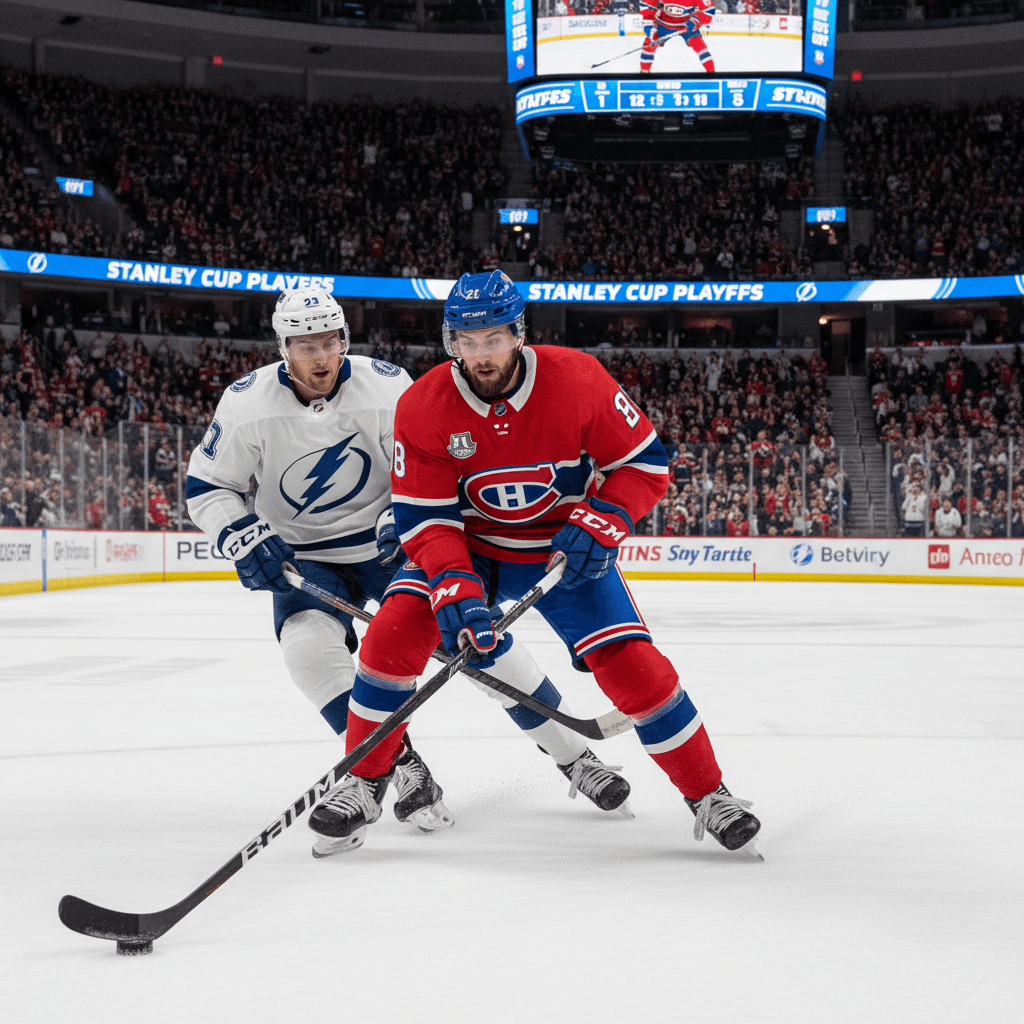
There is no matchup in the 2026 NHL playoff bracket that carries more narrative weight than the Montreal Canadiens against the Tampa Bay Lightning in the Atlantic Division's first round. On one side, the most storied franchise in hockey history, filled with young, hungry players who have grown up hearing about the Canadiens' 24 Stanley Cup championships and who now have the opportunity to add to that legacy. On the other, a veteran-laden Tampa Bay team that has been to multiple Stanley Cup Finals, that has already won championships in this era, and that knows precisely how to manage the pressure of a seven-game series.
This is, in every meaningful sense, a David and Goliath story. Montreal is the underdog. Tampa Bay is the experienced, battle-tested favourite. The predictable outcome is a Lightning victory in five or six games, with Tampa's experience overwhelming Montreal's youth. The unpredictable outcome, the one that keeps playoff hockey compelling, is that Montreal uses their speed and energy to steal home-ice advantage in Game 1 and then turns the series into something that no Vegas odds-maker priced in at the start of April.
This is a full preview of the series, covering the tactical matchup, the individual player battles that will define each game, the historical context of both franchises, and a realistic assessment of what Montreal needs to do to win a series that the wider hockey world assumes Tampa will handle without significant difficulty.
Montreal's Young Core: The Reason to Believe
The Montreal Canadiens' rebuild has taken longer than the franchise's impatient fanbase would have preferred, but the core that emerged from the patience and the difficult decisions is genuinely exciting. Nick Suzuki, the Ontario-born centre who was acquired in the Max Pacioretty trade and who has grown into the team's captain and offensive engine, represents the clearest evidence that the rebuild produced what it was supposed to produce. Suzuki's skating, playmaking, and two-way awareness have made him one of the most complete centres in the Atlantic Division, and his leadership in a market as demanding as Montreal, where the historical weight of the franchise presses on every player who wears the jersey, has been exemplary.
Cole Caufield, the American-born winger who has settled in perfectly alongside Suzuki, is one of the most dangerous shooters in the NHL when he is receiving quality passes in his shooting areas. Caufield does not need much space or much time. A fraction of a second in the circle or at the top of the crease is sufficient for him to get a shot off with the accuracy that has made him one of the most feared goal scorers in the Eastern Conference. Tampa Bay's defence will spend a significant portion of their preparation time designing structures specifically to prevent Caufield from receiving the puck in his preferred zones.
Juraj Slafkovsky, the Slovakian power forward selected first overall in 2022, has had the kind of breakout season that the franchise and its fans were hoping would come but were not certain would arrive this quickly. Slafkovsky's combination of size, skating, and skill is rare, and his development into a legitimate top-line contributor gives Montreal a physical dimension in their top six that they lacked in previous seasons. In a series against Tampa Bay, Slafkovsky's ability to win battles in the offensive zone and create second-chance opportunities will be among the critical factors in whether the Canadiens can generate sustained pressure.
Tampa Bay's Veteran Identity and Current Roster
The Tampa Bay Lightning have been one of the defining franchises of the post-2015 NHL era, reaching multiple Stanley Cup Finals and winning championships in a way that has embedded a culture of winning deep into the organisation. The players who remain from those championship runs carry institutional knowledge that cannot be replicated, and the younger players who have joined the Lightning in recent years have been absorbed into that winning culture in ways that make the entire roster more resilient than their individual talent levels might suggest.
The legacy of Steven Stamkos in Tampa Bay is woven into the fabric of the current team's identity even as the roster has evolved around him. The values of commitment, professionalism, and clutch performance that defined the Lightning during their championship years remain present in how the current group approaches the postseason. Tampa's veterans understand that playoff hockey is a different sport from regular-season hockey, one that rewards composure and execution over athleticism and energy, and that understanding is the team's most significant structural advantage over a young Montreal team experiencing the intensity of a first-round series for the first time.
Tampa Bay's goaltending has been one of the most reliable elements of their playoff success over the years, and in 2026 they enter the series with a crease situation that gives them confidence in the moments when the game is decided by a single save. Against Montreal's offensive weapons, particularly Caufield's shooting ability and Suzuki's playmaking, the Lightning's goaltender will need to be sharp in the early periods of each game when Montreal typically plays with the most energy and determination.
Tactical Breakdown: How Each Team Tries to Win
The tactical contrast in this series is one of the most interesting in the 2026 playoffs. Montreal wants to play fast, generate transition offence, and use their skating to overwhelm Tampa Bay before the Lightning's experience allows them to slow the game down. Tampa wants the opposite: a methodical, half-ice game where their superior experience and puck-management skills allow them to control possession, wear down Montreal's young forwards, and create their offence through structure rather than speed.
The neutral zone will be the primary battleground. Montreal's forecheck, when it generates turnovers in the offensive zone, creates the exact type of quick transition that Tampa wants to prevent. If the Canadiens can consistently beat Tampa Bay's defence to the puck in the neutral zone and force the Lightning to defend with their backs to their own net, Montreal will generate the scoring chances that can win a series. If Tampa Bay manages to regroup cleanly and set up their defensive structure before Montreal arrives in the offensive zone, the Lightning will control the ice and the pace will drop to a level that favours their experience.
Special teams will be decisive. Montreal's power play, built around Suzuki's distribution and Caufield's shooting, has the potential to be very effective against Tampa Bay's penalty kill if they can get the puck to Caufield in his preferred areas before the Lightning's killers can take away the passing lanes. Tampa's power play, featuring veterans who have executed in playoff pressure situations for years, represents a genuine threat against Montreal's penalty kill, which will be tested repeatedly throughout the series as Tampa Bay draws penalties from the Canadiens' aggressive forechecking style.
The Historical Context: Habs Playoff Magic
The Montreal Canadiens have a history of postseason magic that defies statistical probability. Twenty-four championships is a number that no other franchise in professional hockey approaches, and many of those championships were won by teams that, on paper, should not have beaten their opponents. The 1971 Montreal Canadiens won the Cup despite losing the previous year. The franchise has a culture of believing in situations where belief is not logically supported by the facts, and that culture is not merely mythology. It is an actual competitive advantage when transmitted effectively to players who are experiencing playoff hockey for the first time.
Nick Suzuki, as the team's captain, carries the responsibility of transmitting that culture. He was not alive for most of the Canadiens' championships. He did not experience the dynasty years firsthand. But he has been immersed in the organisation's history since being traded to Montreal, and the significance of the jersey he wears is something he has spoken about with genuine understanding of its weight. That understanding, shared across the dressing room, is what allows the Canadiens to play with a certain confidence even as significant underdogs.
For Quebec hockey fans, the Canadiens in the playoffs is a reawakening of something primal. The sport is discussed differently in Quebec than anywhere else in the country. It is more personal, more immediate, more connected to identity and community and the particular way that winter evenings are spent in a province where hockey is not merely entertainment but inheritance. When the Canadiens play in April and May, Quebec pays attention in a way that shapes the cultural atmosphere of the entire province.
What Montreal Needs to Win
For the Montreal Canadiens to upset the Tampa Bay Lightning in the 2026 first round, several things need to happen simultaneously. First, their goaltending needs to be exceptional. Montreal cannot afford to surrender the early goals in games that allow Tampa Bay to slow the pace and manage the score. The Canadiens' goaltender needs to make the saves that keep games within reach in the first and second periods, because if Montreal falls behind by two goals against a Tampa Bay team that manages leads expertly, the task of coming back becomes significantly more difficult.
Second, Suzuki needs to outplay his counterpart at the top of Tampa's lineup. The centre matchup is often the most decisive tactical battle in a playoff series, and if Suzuki can win that battle consistently at 5-on-5 and in the faceoff circle, it will create the puck-possession advantages that fuel Montreal's transition game. A Suzuki who is dominant, who is generating chances and winning draws, is a Suzuki who is pulling Tampa Bay's attention away from Caufield and Slafkovsky, and that attention redistribution creates opportunities across Montreal's entire lineup.
Third, Montreal needs to steal at least one game in Tampa Bay. A team that loses both home games to start a series faces enormous pressure to win consecutive games on the road, and even the best playoff teams find that difficult against veteran opponents. If Montreal can take one of the first two games in Tampa and bring the series back to the Bell Centre tied or with a lead, the dynamics change entirely and the historical weight of Canadiens playoff magic becomes genuinely relevant.
The Series Prediction and What It Means for Quebec
Tampa Bay Lightning in six games is the honest prediction for this series, but honest predictions and playoff hockey have a famously troubled relationship. The Lightning are the better team by most objective measures: more experienced, more structured defensively, and equipped with a goaltender who has performed in playoff moments. Those advantages are real and will matter in the course of a seven-game series.
But Montreal is fast, young, and playing in front of a province that invests its collective emotional energy into these games in ways that affect the atmosphere inside Bell Centre profoundly. Nick Suzuki, Cole Caufield, and Juraj Slafkovsky are playing playoff hockey together for the first time as the team's established core, and first times in hockey can produce unexpected results when the talent is genuine and the hunger is real.
Whatever the outcome, this series will be watched closely by Canadian hockey fans from coast to coast. The Canadiens in the playoffs, facing a credentialed opponent, with the province of Quebec holding its breath and the history of 24 championships visible on every wall of the Bell Centre: that is what the NHL was built for. That is why the sport endures, why it matters, and why April feels different in Montreal than anywhere else in the world.