The MVP Debate Is Over: Why Shai Gilgeous-Alexander Has Earned His Crown
From Hamilton to Superstardom
The basketball journey of Shai Gilgeous-Alexander is not a story that follows a conventional North American sports narrative. He did not come from a major basketball city. He was not a top-five recruit whose every high school performance was streamed nationally. He grew up in Hamilton, Ontario, a city whose identity has historically been defined by steel and labour rather than athletic celebrity, and he played his formative years in Canadian youth basketball programs before eventually earning an American scholarship and developing into the kind of prospect that NBA scouts began following with serious attention.
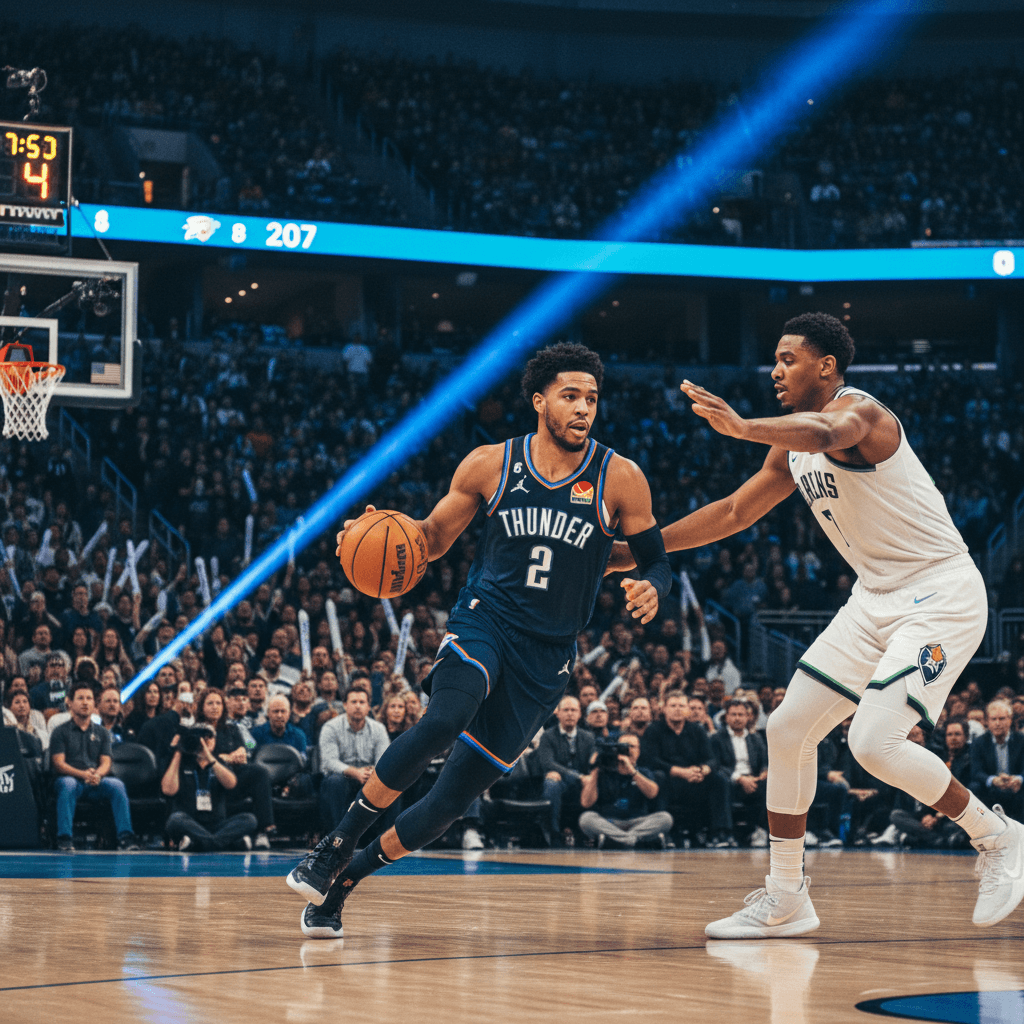
In the spring of 2026, Shai Gilgeous-Alexander is the frontrunner for the NBA's Most Valuable Player award, the leader of the Western Conference's top seed, and arguably the most difficult individual player to defend in professional basketball. The journey from Hamilton to this position of league-wide dominance is one of the most compelling individual narratives in Canadian sports, and its significance extends well beyond the borders of Ontario to a national basketball community that has been watching SGA's development with pride and with the particular investment that comes from recognising a player as genuinely your own.
This is the full case for why Shai Gilgeous-Alexander has earned the 2026 MVP award, what his regular season looked like statistically and contextually, what the race looked like, and what his success means for basketball in Canada.
The Statistical Case: Numbers That Demand Recognition
The MVP conversation in any NBA season begins and ends with statistics, and Shai Gilgeous-Alexander's 2025-26 regular season numbers are the kind that make the award discussion simple for everyone who engages with them honestly. His scoring average placed him among the top three scorers in the league, a position he has occupied in each of the past two seasons, but the efficiency with which he scored is what separates his case from a straightforward counting-stats argument.
SGA's true shooting percentage, which accounts for the relative value of two-pointers, three-pointers, and free throws, was elite for a player generating his volume of shot attempts. Most high-volume scorers see their efficiency decline as their usage rate increases, because defenders pay more attention and the quality of available shots diminishes. SGA has consistently defied this relationship, maintaining elite efficiency at high volume through a combination of footwork, deception, and the particular ability to get to the free-throw line that makes him uniquely cost-effective as an offensive weapon.
His assist numbers reflected the evolution of his game into something more complete than a pure scorer. The Thunder's offence runs through SGA as both a primary ball-handler and a primary scoring threat, and the ability to do both simultaneously, to be the player that generates offence for others while also being the player that finishes at the highest rate, is exceptionally rare at the NBA level. The teams that have successfully built around a player who can do both things simultaneously are teams that win a lot of basketball games, and Oklahoma City's record confirmed precisely that.
Elevating a Young Thunder Roster
Context is everything in the MVP conversation, and the context that surrounds SGA's 2025-26 season makes his numbers more impressive rather than less. The Oklahoma City Thunder are a team built around their franchise star and supplemented with a collection of young players, many of them first or second-year contributors who are still developing the consistency required of playoff-level NBA performers. That roster construction puts enormous responsibility on SGA to perform at his peak level on every night, because the margin for collective error is smaller than it would be on a team with multiple established veterans in the rotation.
The comparison to how the Thunder performed in the games when SGA was slightly below his peak versus the games when he was fully engaged is illuminating. Oklahoma City's record in games where SGA reached a certain usage threshold and efficiency level was among the best in the league. Their record in games where he was below that threshold, whether from foul trouble, minor injury maintenance, or simply the variance that every player experiences, was more modest. That differential, the gap between Thunder-with-peak-SGA and Thunder-without-peak-SGA, is as clear a demonstration of MVP-level value as exists in the league.
The young players around him have developed faster and more completely than development projections suggested at the start of the season, and while their credit for that development belongs in significant part to Oklahoma City's coaching staff, the environment that a franchise player creates around himself is a genuine developmental accelerant. Playing alongside a player who demands the best from himself every night, who never takes a possession off, and who holds the organisation's competitive standard to the highest level is the most effective teacher a young NBA player can have.
The MVP Race and Its Competitors
Every MVP season has a narrative structure, a story about which players were in the conversation at different points of the year and how the race ultimately resolved. The 2025-26 race was no different, featuring several legitimate candidates at various points of the season before the statistical accumulation and the team performance indicators combined to make SGA's case essentially unanswerable in the final two months of the regular season.
The other players who generated significant MVP discussion were all legitimate candidates at various points. A veteran Eastern Conference star with multiple All-Star appearances had a season that would have won the award in most years. A young big man who made a significant developmental leap in his fourth season generated enthusiastic support from analytics-focused voters who valued his impact on his team's defensive rating. A guard on a high-seeded Eastern Conference team made a statistically compelling case that rivalled SGA's in raw production numbers, though the team-performance dimension of the award ultimately favoured Oklahoma City's top seed over the Eastern team's lower seeding.
What separated SGA's case from each of these alternatives was the combination factor. He was not the best scorer or the best defender in isolation. He was the player whose combination of scoring, playmaking, defence, and winning placed him unambiguously ahead of every other candidate when the full picture was considered. That is, ultimately, what the MVP award is designed to recognise: the player whose total impact on his team's success was most indispensable, and by that measure, SGA's case was the strongest in the league.
The Canadian Narrative: From Hamilton to the Top of the League
The specific geography of Shai Gilgeous-Alexander's origin matters in a way that goes beyond hometown pride. Hamilton, Ontario is a mid-sized Canadian city that does not typically produce NBA MVPs. It produces hockey players, because every Canadian city with cold winters and a nearby rink produces hockey players, but basketball at the elite development level has historically been concentrated in cities with deep youth infrastructure, major university pipelines, and the networks of coaches and scouts that direct young talent toward the highest levels of the sport.
SGA's development in Hamilton, and in the broader Canadian basketball system, reflects the changes that have transformed the country's relationship with the sport over the past two decades. The immigration-driven demographic shifts in cities like Hamilton, Mississauga, Toronto, and Montreal have produced a generation of young Canadians who grew up with basketball as their primary sport rather than hockey. The community leagues, the high school programs, the provincial training systems, and eventually Canada Basketball's national development structure absorbed that generation and began producing NBA-calibre talent in volumes that were unimaginable a generation earlier.
Gilgeous-Alexander's trajectory through Canadian youth basketball to an American high school program to the University of Kentucky to a top-10 NBA draft selection is a path that is now being replicated by younger Canadian players who look at SGA, at RJ Barrett, at Jamal Murray, at the entire generation of Canadian NBA stars, and understand that the path from a Canadian city to the NBA is real and navigable. That understanding is changing the youth basketball landscape in Canada in ways that will produce the next generation of SGA-calibre talents within the decade.
What the Thunder's Playoff Run Looks Like
The Oklahoma City Thunder enter the 2026 NBA playoffs as the Western Conference's top seed and one of the three or four teams with a realistic path to the NBA Finals. SGA's MVP season has been built on a foundation of regular-season excellence, and the question that always accompanies individual excellence is whether it translates to team success in the postseason, where game plans are specifically designed around limiting the best player and where the margins between winning and losing are thinner than in the regular season.
The Thunder's first-round matchup is a situation where SGA's regular-season reputation precedes him in a way that creates specific defensive challenges. Every team in the playoffs has spent time preparing for SGA specifically, building defensive schemes around limiting his drives to the basket, taking away the step-back three that is his most reliable individual creator, and using their best perimeter defender to make his nights as difficult as possible. How SGA navigates those defensive adjustments in the first round will reveal whether his offensive arsenal has the depth to produce even when the league's best defenders are deployed against him.
The second round, if Oklahoma City advances, will feature either the Denver Nuggets or a high-seeded Eastern-adjacent opponent, and that matchup will test the Thunder's ability to win games in which SGA is held below 25 points through a combination of talented defending and help-defence schemes. The teams that consistently reach Conference Finals are teams that can win when their best player is not at his absolute peak, and the depth questions around Oklahoma City's supporting cast will be answered in those moments.
What SGA's Success Means for Basketball in Canada
Shai Gilgeous-Alexander winning the 2026 NBA MVP award is not merely a sports result. It is a cultural event for Canadian basketball, a validation of the infrastructure and investment that have gone into developing elite basketball talent in a country whose national sports identity was built almost entirely around hockey. The significance is felt differently in different communities, but it is felt everywhere that young Canadian basketball players are working to develop their game with the ambition of reaching the NBA.
Canada Basketball, the national governing body that oversees player development from the youth levels through the national team program, has invested significantly in the infrastructure that allows talents like SGA to emerge and reach the NBA prepared to contribute at the highest level. The national under-17 and under-19 programs, the relationship with the NBA's Basketball Without Borders initiative, and the broader professionalisation of youth basketball development in Canada are all part of the ecosystem that SGA's generation benefited from and that the next generation is navigating today.
The legacy that SGA is building, alongside Barrett, Murray, and the rest of Canada's NBA generation, is a legacy that will outlast their individual careers. It is the legacy of demonstrating, conclusively and repeatedly, that Canadian basketball can produce the best players in the world, not occasionally or accidentally, but systematically and sustainably. That demonstration is the most important thing happening in Canadian sports right now, and it is happening in full view of every young basketball player in every gym and outdoor court in the country.